Coast FIRE with kids: how to plan around the expensive years
By Gourav Boruah · November 5, 2026 · 8 min read

Coast FIRE with kids is very doable, because the most expensive part of having children usually lasts a limited number of years. If you cut or pause retirement saving during those years, your stop-saving age moves later, but the money you already have keeps growing the whole time. In our worked example, a couple who stop saving completely for six years can still stop saving for good at 52, fifteen years before they retire.
Want your own number first? Use the Coast FIRE calculator. It takes a minute and nothing is sent anywhere.
New here? What is Coast FIRE explains the idea. In short: Coast FIRE is the point where the money you already have can grow into your full retirement pot on its own, so you can stop saving for retirement.
The squeeze many parents feel
A baby arrives, and the monthly sums change overnight. Saving for retirement with kids can suddenly feel impossible, and many parents end up stuck with the same worries:
- “We used to save a lot. Now we save almost nothing.” Childcare, a bigger home and nappies eat the gap.
- “Have we ruined our retirement?” Missing a few years of saving feels like falling off a cliff.
- “Should we keep forcing the savings and stay exhausted?” Some parents keep a stressful job only to keep the pension payments going.
- “How long will this last?” Without a number, the squeeze feels endless.
The cost is real. The US Department of Labor’s childcare price data found that in 2022, full-day care for one child cost between $6,552 and $15,600 a year, depending on the area and type of care. That was 8.9% to 16% of a typical family’s income.
The good news: Coast FIRE turns the vague worry into one clear question. If we save less for a few years, how much later can we stop saving? You can answer that in minutes.
Why the expensive years don’t wreck the plan
Three things work in your favour.
- The heaviest costs end. For many families, the cost of full-time childcare falls once children start school. Many of the other costs fade when children leave home.
- Your money keeps growing while you pause. Saving nothing is not the same as going backwards. What you have already invested keeps compounding.
- Retirement spending usually doesn’t include the children. By the time you retire, they are likely to be grown up. Your retirement budget should reflect the life you will have then, not the one you have now.
That third point matters more than most people think. We come back to it below.
A worked example: Maya and Daniel at 32
Meet Maya and Daniel. They are both 32 and expecting their first child. Together they have $80,000 invested for retirement and save $1,200 a month. They want to retire at 67. Once the children are grown, they expect to spend $60,000 a year, and their combined pensions (or Social Security) should be about $30,000 a year.
They expect six expensive years, from birth until school starts. We use the calculator’s defaults: 7% growth, 3% inflation and a 4% withdrawal rate. Coast FIRE for couples explains how to enter a household.
Step 1: The pot they need at 67. ($60,000 − $30,000) ÷ 0.04 = $750,000.
Step 2: Real growth. (1 + 0.07) ÷ (1 + 0.03) − 1 = 3.88% a year after inflation.
Step 3: How much $1 grows to in 35 years. 1.0388 multiplied by itself 35 times = about 3.794.
Step 4: Their Coast FIRE number today. $750,000 ÷ 3.794 = about $197,666. Their $80,000 is 40.5% of the way there.
Step 5: When they can stop saving. If they keep saving $1,200 a month, their money passes the amount needed at 43. They have about $314,682 by then, just above the $300,569 they need at that age.
What happens if they pause for six years
Now the baby arrives and saving stops completely for six years. Nothing is taken out. The $80,000 just sits and grows.
By 38, it has grown to about $100,547 in today’s money, with no new saving at all. Then they go back to $1,200 a month.
They can now stop saving at 52, with about $432,712 invested against the $423,509 needed. That is nine years later than if nothing had changed. But it is still 15 years before they retire, and they did not have to squeeze every dollar while the children were tiny.
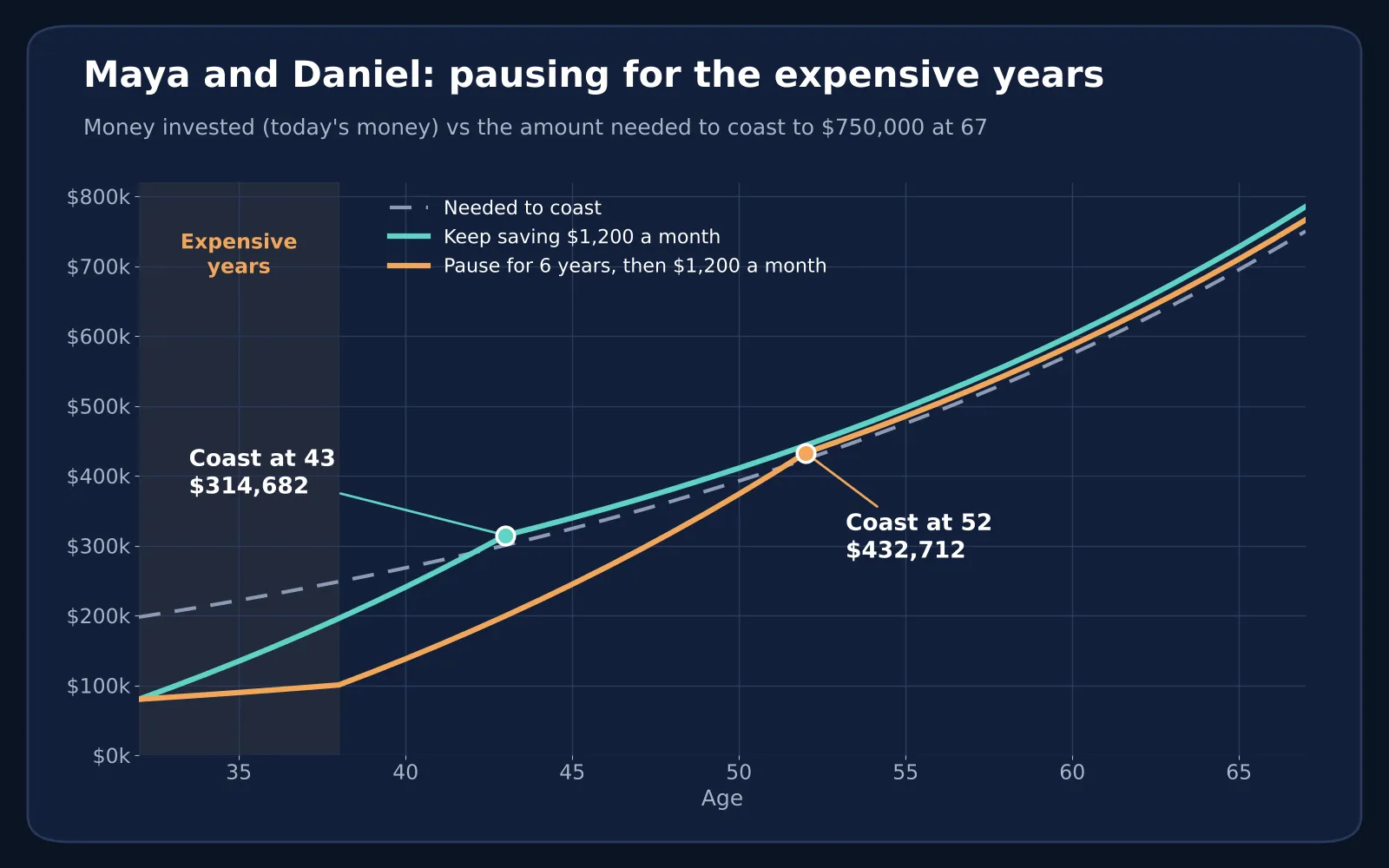
The pause costs them nine more years of saving later, not their retirement.
Five ways to handle the expensive years
Pausing is only one option. We ran Maya and Daniel’s plan five ways, changing only their monthly saving.
| What they do for six years | What they do after | Age they can stop saving |
|---|---|---|
| Keep saving $1,200 a month | Keep going | 43 |
| Cut to $300 a month | Raise to $1,500 a month | 47 |
| Cut to $300 a month | Back to $1,200 a month | 49 |
| Pause completely | Raise to $1,500 a month | 49 |
| Pause completely | Back to $1,200 a month | 52 |
Two lessons stand out:
- A small amount beats nothing. Keeping just $300 a month going brings their stop-saving age from 52 to 49.
- A catch-up after the squeeze helps a lot. Saving $1,500 instead of $1,200 once childcare ends wins back two or three years, depending on what they did during the squeeze.
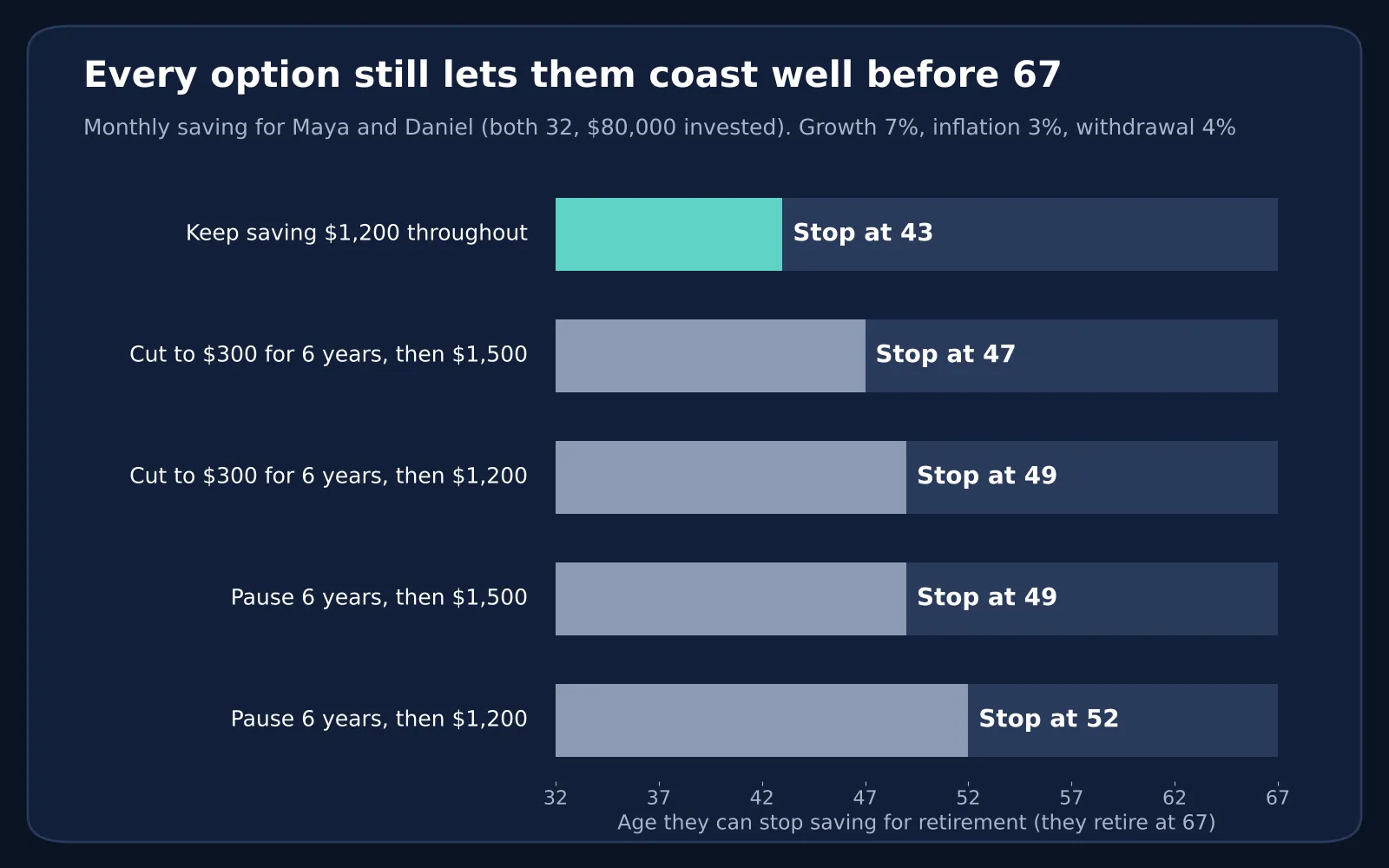
Every option still lets them coast well before 67. The choice is about trade-offs, not failure.

The costly mistake: counting today’s childcare in retirement
Here is the trap. Maya and Daniel currently spend about $75,000 a year, including childcare. If they typed that into the calculator as their retirement spending, they would get a very different answer:
- Pot needed: ($75,000 − $30,000) ÷ 0.04 = $1,125,000, not $750,000.
- Coast FIRE number today: about $296,499, not $197,666.
- Stop-saving age, saving $1,200 throughout: 56, not 43.
That is 13 extra years of saving to fund costs they will not have at 70. Use your best guess for life after the children are grown. How to estimate what you will spend in retirement walks through it line by line.
How to model your own expensive years in the calculator
The calculator uses one monthly saving amount, so you run it twice. It takes about five minutes:
- Run your normal plan. Open the calculator, enter your ages, savings and normal monthly saving, and your retirement spending without children. Note your stop-saving age.
- Run the worst case. Change only the monthly saving to what you can manage during the squeeze, even $0. This shows what happens if the squeeze never ended. Your real answer sits between the two.
- For an exact answer, jump ahead. Work out what your money grows to during the pause: multiply today’s amount by 1.0388 once for every year you expect it to last. For six years, that is about × 1.2568. Maya and Daniel: $80,000 × 1.2568 ≈ $100,547.
- Enter that future picture. Set your age to when the squeeze ends (38 for them), type the grown amount as your invested money, and enter the saving you plan from then on. The stop-saving age you see is your answer.
- Try a catch-up. Raise the monthly saving a little and watch the age come down.
The 1.0388 comes from the default 7% growth and 3% inflation. If you change those, the methodology page shows how real growth is worked out.
Things to settle before you pause
This is general education, not advice for your situation. Rules and products differ by country.
- Keep an emergency fund. Children make surprise costs more likely. Emergency fund first or Coast FIRE first? explains the order.
- Check any free money from your employer. In many workplace plans, your employer adds money when you save. Find out what you would give up before you cut your own payments to zero.
- Pause new saving, not your investments. Leaving the money invested is what makes the plan work. Cashing it out undoes the growth.
- Look at the help available where you live. Many governments offer childcare support or tax help for families. Check your government’s official website.
- Set a date to restart. Put a reminder in your calendar for when the costs are due to drop, and run the calculator again then.
If one parent is thinking about part-time work or time out instead, Coast FIRE, part-time work and career breaks shows how to test that too.

Coast FIRE with kids: questions people ask
Should my retirement spending include my children? Usually not the day-to-day costs, because most children are grown by then. If you plan to help them with a home deposit or grandchildren, add a sensible yearly amount.
What about saving for their university or college? That is a separate goal with a different date. Keep it out of your retirement numbers and plan it on its own.
Is it better to cut saving or stop it completely? In Maya and Daniel’s case, keeping $300 a month going brought their stop-saving age three years earlier. Any amount helps, but stopping does not ruin the plan.
We already have children and saved nothing yet. Is it too late? No. Start from where you are today. Once the costs fall, the calculator will show you what a realistic monthly amount can do.
Work out your own number
The expensive years are a season, not a sentence. Knowing your number lets you ease off without guilt, and pick a date to switch back on.
Find your Coast FIRE number. It works for singles and couples, includes pensions, and shows every step of the maths with your own figures. Run it once with your normal saving and once with your squeeze-years saving, and see how far apart the two answers really are.
This article is for education, not financial advice. All figures are in today’s money and do not include taxes or fees.
What is your Coast FIRE number?
Find the age you can stop saving for retirement. Free, no sign-up, and your numbers stay on your device.
Find your own Coast FIRE numberPhotos: William Fortunato, Gustavo Fring, RDNE Stock project on Unsplash.