How much will you spend in retirement? How to estimate retirement expenses
By Gourav Boruah · October 28, 2026 · 9 min read

The best way to estimate what you will spend in retirement is to start with what you spend today, not what you earn. Take off the costs that will end when you stop working, add the costs that will start or grow, and you have a first estimate in today’s money. It matters more than almost any other number in your plan: at a 4% withdrawal rate, every $1,000 a year of spending needs $25,000 more in your retirement pot.
Want your own number first? Use the Coast FIRE calculator. It takes a minute and nothing is sent anywhere.
New to the idea? What is Coast FIRE covers the basics. In short: Coast FIRE is the point where the money you already have can grow into your full retirement pot on its own, without any more saving.
Why this one number matters so much
The Coast FIRE calculator asks for your yearly spending in retirement. Most people type in a round number and move on. That is a pity, because this guess drives everything else.
Here is why. The pot you need is:
(spending − pension) ÷ withdrawal rate
At a 4% withdrawal rate, dividing by 0.04 is the same as multiplying by 25. So every extra $1,000 a year you plan to spend means $25,000 more you need at retirement. Guess $6,000 a year too high, and you are aiming for a pot $150,000 bigger than you need. Guess too low, and you may stop saving too early. The 4% rule explained covers where that rate comes from.
So it is worth spending twenty minutes on this number. Here is how.
How to estimate retirement expenses in five steps
- Add up what you spend today. Use a year of bank and card statements if you can, so you catch yearly bills like insurance and gifts. Leave out what you save or invest. That is not spending.
- Cross out costs that will end. A mortgage that will be paid off, commuting, work clothes, lunches out on work days, and the money you put into retirement savings.
- Add costs that will start or grow. Health costs often rise with age. You may want more travel and hobbies in the early years, when you have more free time. An older home needs repairs.
- Split it into must-haves and nice-to-haves. Must-haves are housing, food, bills, transport and health. Nice-to-haves are travel, eating out and gifts. This shows how much you could cut if you had to.
- Check it against a rule of thumb, then put it in the calculator. If your figure is far from the rules of thumb below, look again at what you might have missed. Then enter it and see what it does to your number.
Write everything in today’s money. The calculator handles inflation for you through its growth setting, so you do not need to guess what a loaf of bread will cost in 2058. Why 7% growth is not really 7% explains how that works.

A worked example: Maya at 35
Meet Maya. She is 35, earns $75,000 a year before tax, has $90,000 invested for retirement and saves $700 a month. She plans to retire at 67 and expects a state pension (or Social Security) of about $16,000 a year from then.
Last year she spent $50,000, not counting her saving. Here is how she turned that into a retirement estimate:
| Cost | Today | In retirement | Why it changes |
|---|---|---|---|
| Mortgage | $15,000 | $0 | Paid off at 58 |
| Home bills (energy, water, phone, insurance) | $5,000 | $5,000 | No change |
| Home repairs and upkeep | $0 | $4,000 | Older home, more time at home |
| Food | $8,000 | $8,000 | No change |
| Transport | $6,000 | $3,500 | No commute, but she keeps a car |
| Health | $3,000 | $7,000 | Likely to rise with age |
| Holidays and fun | $6,000 | $9,000 | More free time in the early years |
| Everything else | $7,000 | $5,500 | No work lunches or work clothes |
| Total | $50,000 | $42,000 |
Her estimate is $42,000 a year in today’s money. Of that, about $32,500 is must-haves and $9,500 is nice-to-haves (holidays and fun, plus a little of “everything else”).
Now the maths, using the calculator’s defaults: 7% growth, 3% inflation and a 4% withdrawal rate.
Step 1: The pot she needs at 67. ($42,000 − $16,000) ÷ 0.04 = $650,000.
Step 2: Real growth. (1 + 0.07) ÷ (1 + 0.03) − 1 = 3.88% a year. That is growth after inflation.
Step 3: How much $1 grows to in 32 years. 1.0388 to the power of 32 = about 3.384.
Step 4: Her Coast FIRE number today. $650,000 ÷ 3.384 = about $192,000 (the calculator’s exact figure is $192,054.13).
Maya has $90,000, so she is 46.9% of the way there. If she keeps saving $700 a month, she reaches Coast FIRE at 52. From then on she can stop saving for retirement, and her money grows to about $653,611 by 67.
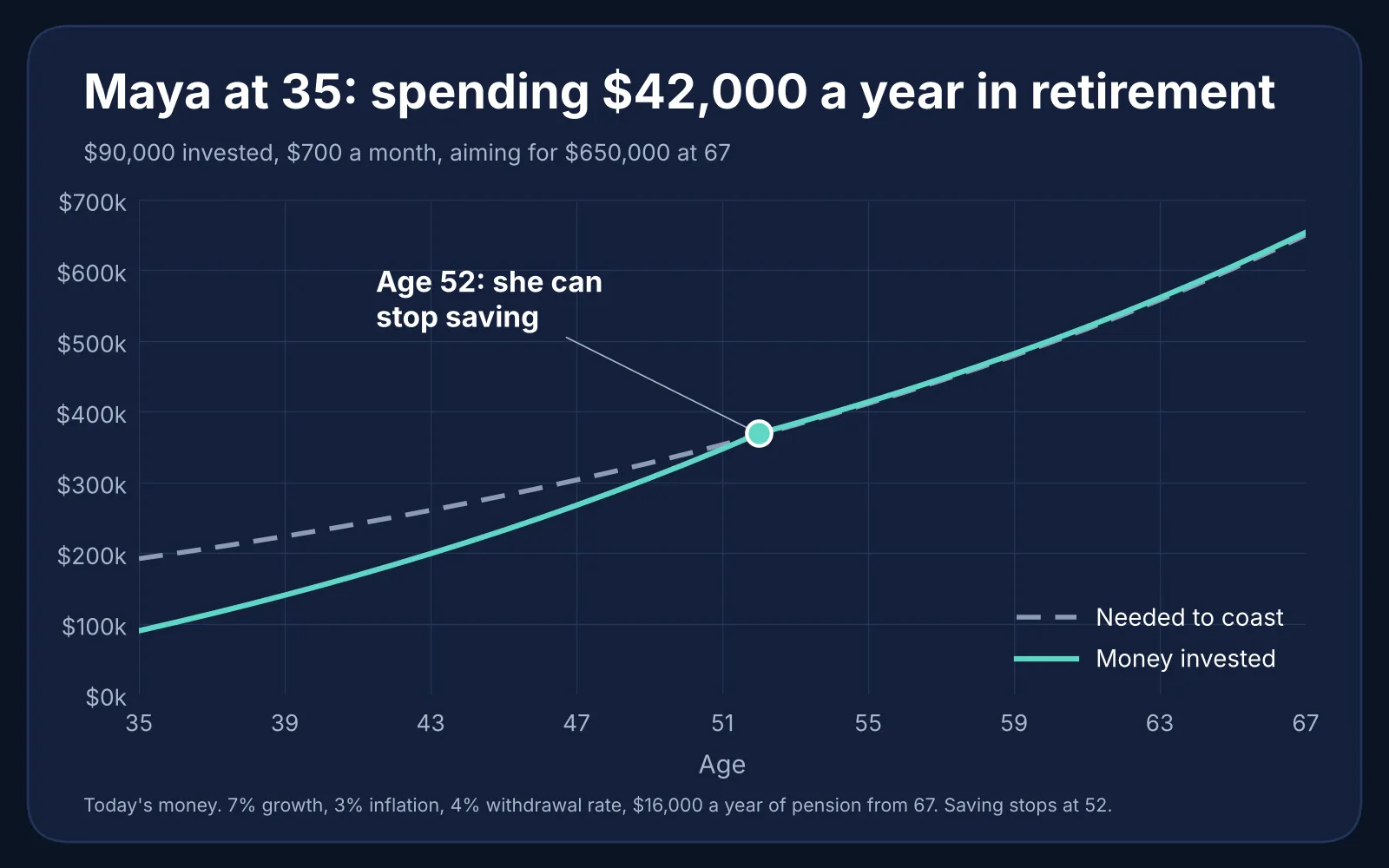
With a $42,000 spending estimate, Maya’s money meets the amount needed to coast at 52.
Compare it with the 80% rule
You may have heard that you will need about 70% to 80% of your income in retirement. It is a quick rule of thumb, and many planning sites use it.
For Maya, 80% of $75,000 is $60,000 a year. That is $18,000 a year more than her own estimate. Why the gap? Her income pays for things she will not have in retirement: her saving, her mortgage, and taxes on her working pay.
The difference is huge:
- With $42,000, she needs $650,000 and can stop saving at 52.
- With $60,000, she needs $1,100,000. Her Coast FIRE number today would be about $325,015, and even saving $700 a month all the way to 67 she would reach only about $820,361, about $279,639 short.
So an income rule can make your goal look much further away than it really is, especially if you save a lot or will have paid off your home. It can also be too low if you plan to travel a lot or have high health costs. Use it as a check, not as your answer.
What a different guess does to your Coast FIRE number
Small changes in your spending estimate move your stop-saving age a lot. Here is Maya, with everything else the same:
| Yearly spending in retirement | Pot needed at 67 | Coast FIRE number today | Age she can stop saving |
|---|---|---|---|
| $36,000 | $500,000 | $147,734 | 44 |
| $42,000 (her estimate) | $650,000 | $192,054 | 52 |
| $46,200 (estimate + 10%) | $755,000 | $223,078 | 61 |
| $48,000 | $800,000 | $236,374 | 65 |
| $60,000 (80% of income) | $1,100,000 | $325,015 | Not before 67 |
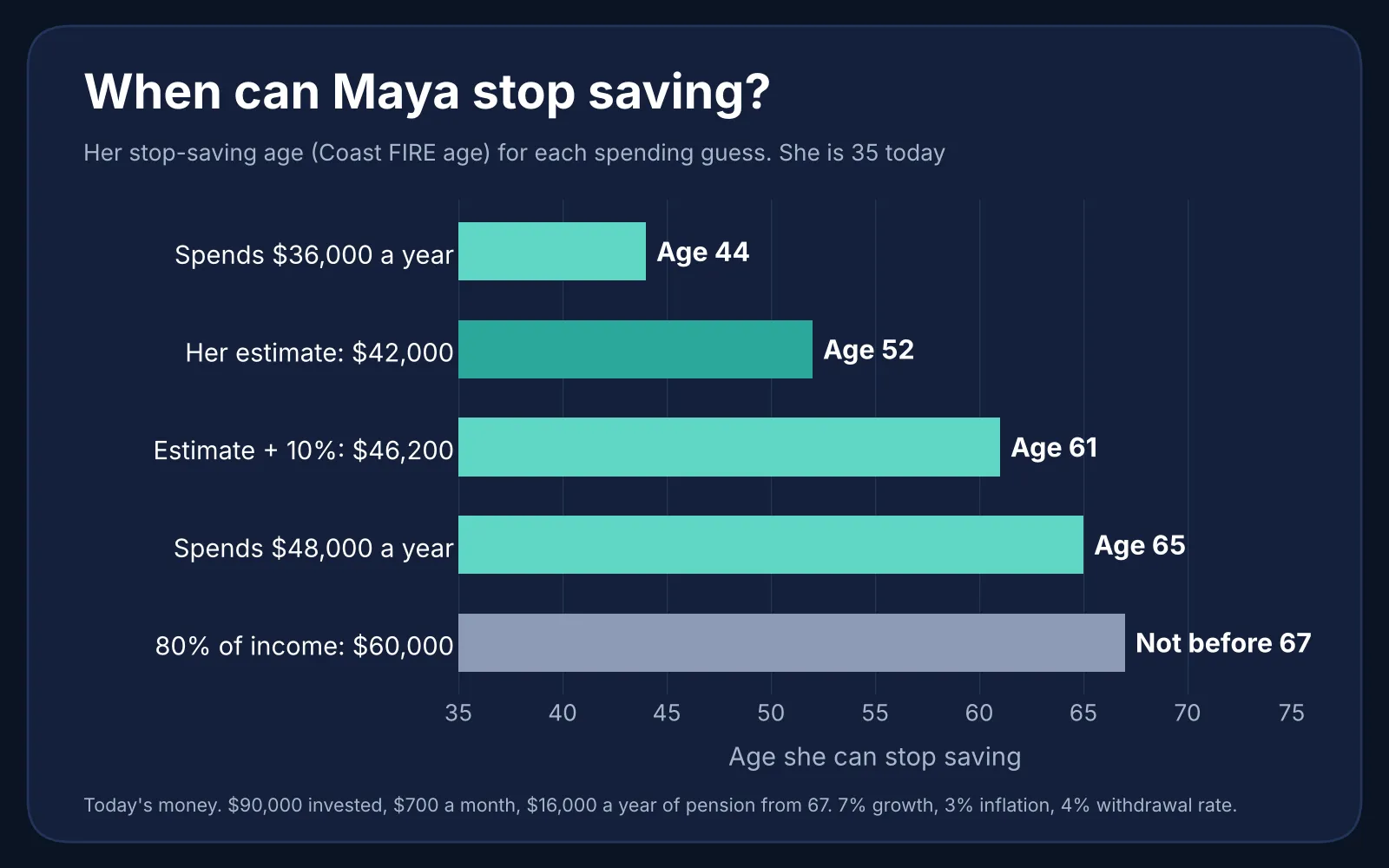
Each $1,000 a year of spending adds about $7,387 to Maya’s Coast FIRE number today.
Why such a big jump in age? Maya is still a long way from her number, and she is saving a modest amount. When you are close to the line, a small change pushes the crossing point years away. If you are already well past your number, the same change matters much less.
Should you add a safety buffer? Some people add 10% to cover things they forgot. That is a fair choice, but look at the cost: for Maya, a 10% buffer means nine more years of saving. Another approach is to keep the honest estimate, then re-check it every year or two as life changes. You can also try both numbers in the calculator and see which plan you are comfortable with.
What real retirees spend
It helps to see what older households really spend. The US Bureau of Labor Statistics runs a large survey of household spending each year. In its 2024 tables by age, average yearly spending was:
- $84,946 for households led by someone aged 55 to 64
- $65,354 for ages 65 to 74
- $55,834 for ages 75 and over
- $78,535 for all households
Two things stand out. Older age groups spend less on average: households led by someone aged 65 to 74 spent about $19,600 less than those aged 55 to 64. But these are averages across very different households, of different sizes and incomes, and some of them are still working. Your own spending is a much better guide than any average. Use these figures only as a sense check.
One more point for US readers: health costs before 65 can be a big item if you retire early, because most people first become eligible for Medicare at 65. In other countries the rules and costs are different, so check your own country’s health system.

Spending changes over time
Your spending will probably not be a flat line for thirty years. A common way to picture it is in three stages:
- The early years. More travel, hobbies and time with family. Often the most expensive part.
- The middle years. A slower pace. Spending often drops.
- The later years. Less travel, but health and care costs can rise.
You do not need to model all of this. A single yearly figure in today’s money is a sensible starting point, and it is what the calculator uses. Just make sure your figure can cover the more active early years.
If you also have a pension, remember the calculator only needs your investments to cover the gap between your spending and your pension. Coast FIRE with a pension shows how to count yours safely.
How to estimate retirement expenses: questions people ask
Is the 80% rule accurate? It is a rough guide. It can be too high if you save a lot, pay off your home before retiring, or will pay less tax. It can be too low if you plan a lot of travel or expect high health costs. Your own spending is a better starting point.
Should I use my spending or my income? Your spending. Your income includes saving and tax on your working pay, which you will not have in the same way in retirement.
Should I include taxes? The calculator does not include tax, so treat your number as a before-tax estimate. If you will pay tax on your retirement income, your real spending power will be a little lower. Every setting is explained on the methodology page.
How often should I update my estimate? Once a year is plenty, and whenever something big changes: a move, a new mortgage, children, or a new job.
Work out your own number
You do not need a perfect forecast. Start from what you spend today, take off what will end, add what will grow, and you have an estimate you can trust far more than a guess.
Find your Coast FIRE number. It works for singles and couples, includes pensions, and shows every step of the maths with your own figures. Try your estimate, then try it 10% higher, and see how much your stop-saving age moves.
This article is for education, not financial advice. All figures are in today’s money and do not include taxes or fees.
What is your Coast FIRE number?
Find the age you can stop saving for retirement. Free, no sign-up, and your numbers stay on your device.
Find your own Coast FIRE numberPhotos: Kampus Production, Mikhail Nilov, Kampus Production on Unsplash.