Emergency fund or invest first? The Coast FIRE answer, in real numbers
By Gourav Boruah · October 31, 2026 · 9 min read

Emergency fund or invest first? For most people, build a small cash emergency fund first, then invest. The one exception: if your employer adds money to your pension or retirement plan when you pay in, keep getting that while you build the fund. Pausing your investing for a short while feels like falling behind, but the numbers below show it costs about the same as one surprise bill, and it protects you from every surprise after that.
Want your own number first? Use the Coast FIRE calculator. It takes a minute and nothing is sent anywhere.
New to the idea? What is Coast FIRE covers the basics. In short: Coast FIRE is the point where the money you already have can grow into your full retirement pot on its own, without any more saving.
Why this question feels so hard
If you are working towards Coast FIRE, you probably have two worries pulling in opposite directions:
- “If I stop investing to save cash, I fall behind.” Every month not invested is a month of growth missed.
- “If I don’t keep cash, one bad month wrecks my plan.” A car repair, a vet bill or a lost job, and you are selling investments or reaching for a credit card.
Both worries are fair. The good news is that you do not have to guess. You can put both choices through the same maths and see which one really costs more.
How big should an emergency fund be?
An emergency fund is cash you keep for surprises: money you can reach in a day or two, that does not go up and down with the stock market.
The UK government-backed guide MoneyHelper on emergency savings suggests aiming for three to six months of essential outgoings, kept in an instant-access savings account. Essential outgoings are the bills you must pay: rent or mortgage, food, power, transport, insurance and minimum debt payments. Not holidays or meals out.
So if your essentials are $2,500 a month, three months is $7,500, and six months is $15,000.
You are not alone if you have nothing yet. In the US Federal Reserve’s survey of household finances for 2025, 63% of adults said they would cover a $400 surprise expense with cash or its equivalent. That leaves more than a third who would need to borrow, sell something or could not pay it at all.

A worked example: Maya at 31
Meet Maya. She is 31, has $45,000 invested for retirement and saves $600 a month. She wants to retire at 67, expects to spend $40,000 a year, and expects a pension (or Social Security) of about $18,000 a year.
Her essential bills are $2,500 a month, so a three-month emergency fund would be $7,500. Right now she has almost no cash.
We use the calculator’s defaults: 7% growth, 3% inflation and a 4% withdrawal rate.
Step 1: The pot she needs at 67. ($40,000 − $18,000) ÷ 0.04 = $550,000.
Step 2: Real growth. (1 + 0.07) ÷ (1 + 0.03) − 1 = 3.88% a year. That is growth after inflation. Why 7% growth is not really 7% explains this step.
Step 3: How much $1 grows to in 36 years. 1.0388 to the power of 36 = about 3.942.
Step 4: Her Coast FIRE number today. $550,000 ÷ 3.942 = about $139,536.
Maya has $45,000, so she is 32.2% of the way there. If she already had an emergency fund and kept investing $600 a month, she would reach Coast FIRE at 50.
But she does not have one. So she has three real choices.
Choice 1: Pause investing for a year and build the fund
Maya sends her $600 a month to a savings account instead. After a year she has about $7,200 in cash, close to her $7,500 goal. Her $45,000 keeps growing, but she adds nothing to it that year.
She reaches Coast FIRE at 52.
Choice 2: Split her saving for two years
Maya sends $300 a month to cash and $300 to her investments. It takes about two years to build the fund, but she never stops investing completely.
She also reaches Coast FIRE at 52. Splitting feels better, but in this example the result is the same as pausing.
Choice 3: Keep investing everything and hope
Maya keeps investing $600 a month and has no cash. Then a surprise arrives. Here is what happens to her stop-saving age when she has to sell investments to pay for it:
| What happens to Maya | Age she can stop saving |
|---|---|
| Already has a fund, keeps investing $600 | 50 |
| Choice 1: pauses for a year to build the fund | 52 |
| Choice 2: splits $300 / $300 for two years | 52 |
| No fund: one $7,500 surprise, paid by selling investments | 52 |
| No fund: the same $7,500 sold during a 30% market fall | 54 |
| No fund: a $7,500 surprise at 31 and another at 36 | 55 |
| No fund: loses her job and sells $15,000 to get by | 55 |
Look at the first “no fund” row. One surprise costs her the same two years as building the fund. But the fund is a one-off cost. Without it, every surprise takes another bite.
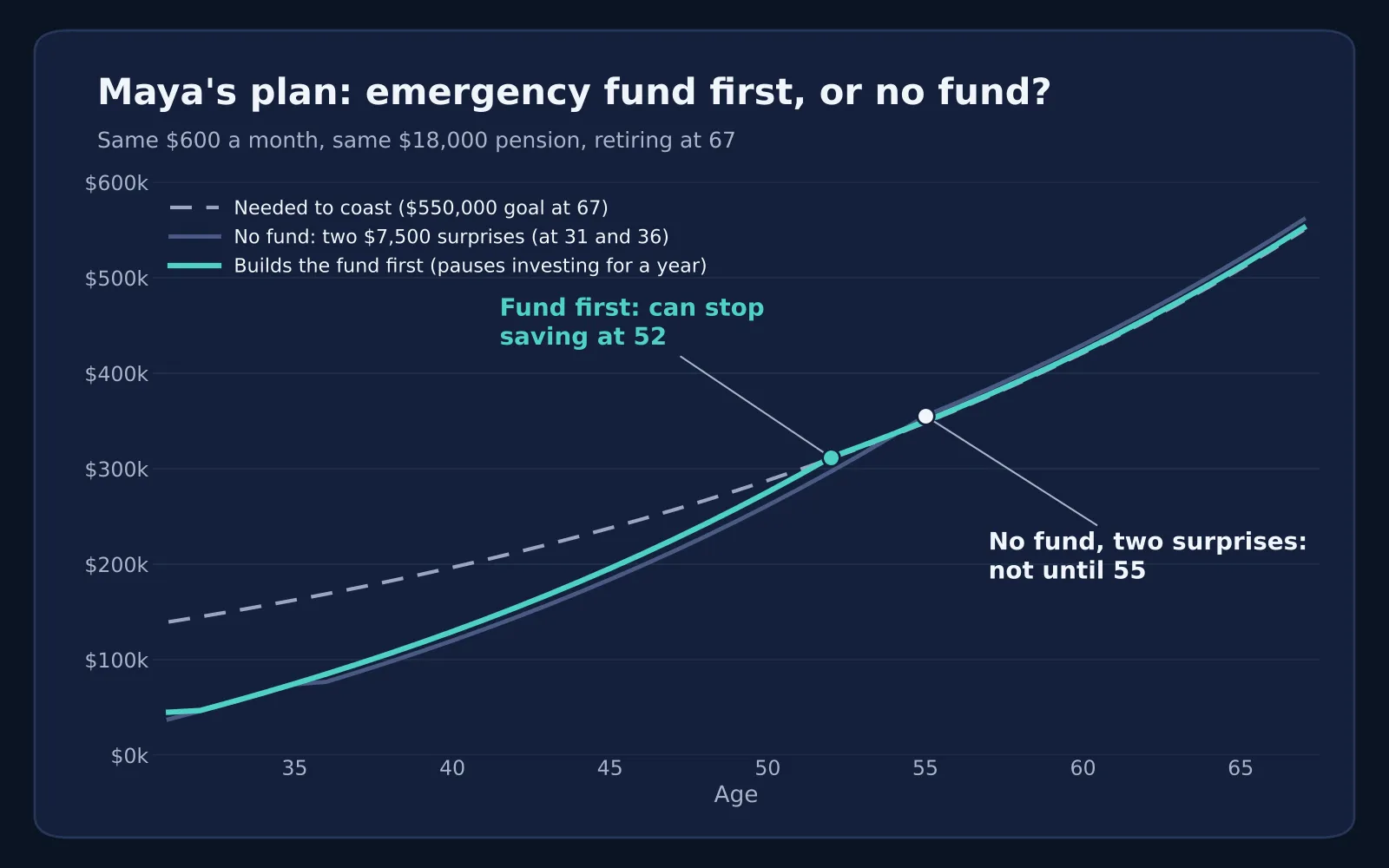
Building the fund first costs Maya two years once. With no fund, two surprises cost her five.
Why the emergency fund usually wins
The table shows the money. Real life adds three more reasons.
1. Surprises do not come one at a time. Over 36 years, Maya is likely to face many car repairs, dental bills and broken boilers. With a fund, she pays from cash and refills it. Without one, each surprise comes out of her retirement money, and the years add up.
2. Bad news often arrives together. Job losses are more common when the economy is weak, and that is often when share prices are low too. Selling then means selling more shares for the same cash, and those shares miss the recovery. That is why the same $7,500 costs Maya two extra years if she sells during a 30% fall. What a market crash does to your Coast FIRE plan explains why holding on through a fall matters so much, and cash is what lets you hold on.
3. The other ways to pay are often worse. If the money is in a retirement account, taking it out early can mean taxes or penalties, depending on your country and the type of account. If it goes on a credit card, the interest is usually far higher than the 7% growth used here. Neither shows up in the table above, so in real life a surprise without a fund often costs more than it shows.
There is also the feeling. Knowing you can cover three months of bills makes it much easier to leave your investments alone and let them do their job. That calm is a big part of what Coast FIRE is for.
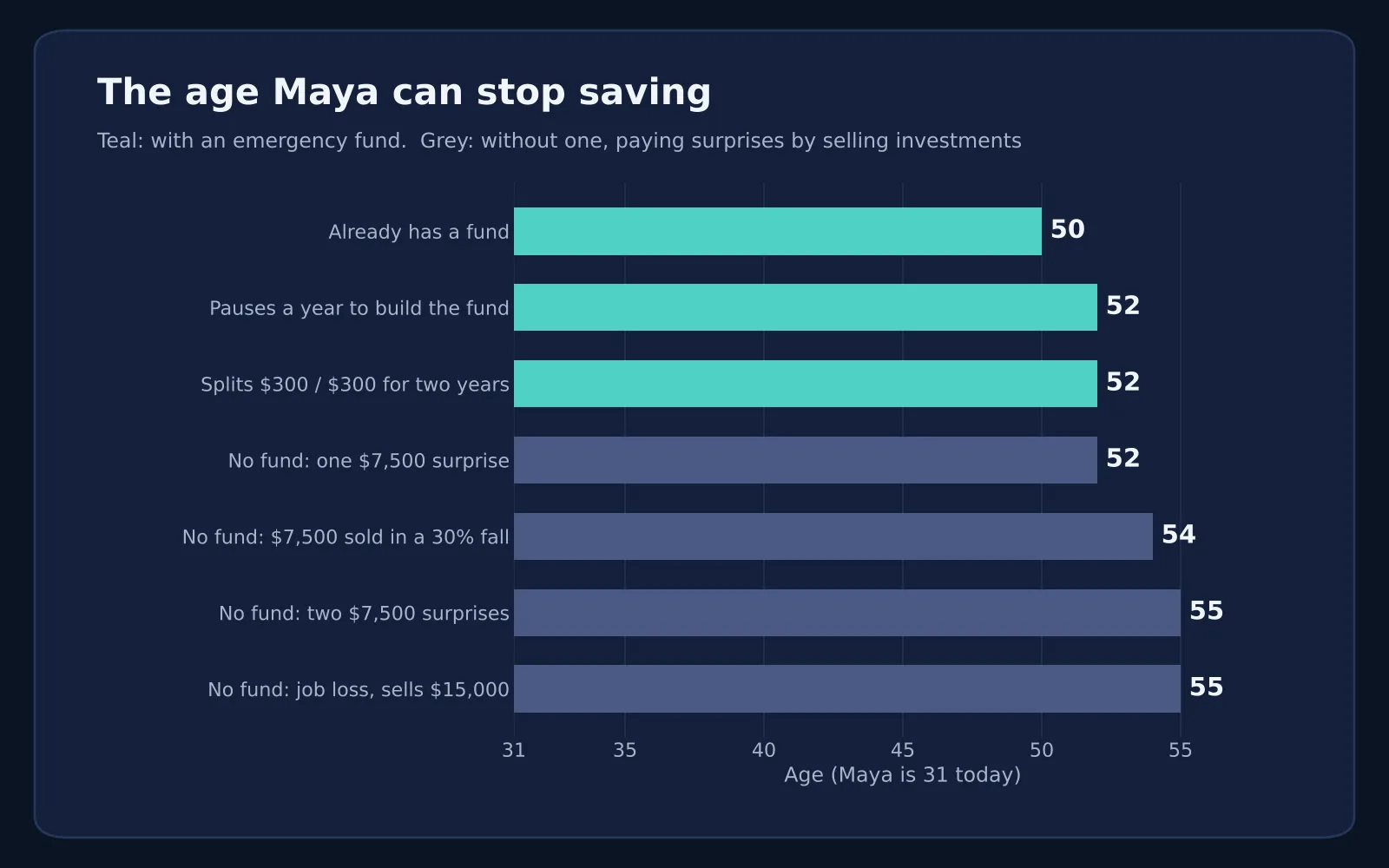
Building a fund costs Maya about two years, once. Going without can cost her up to five.
A simple order to follow
This order works for most people. Your own situation may differ, so treat it as a starting point.
- Get any free money from your employer. If your employer adds to your pension or retirement plan when you pay in, keep paying in enough to get all of it. MoneyHelper’s guide to paying off debt, saving or investing first puts it plainly: do not miss out on employer pension contributions.
- Save a small starter fund. One month of essential bills is a good first goal. It covers most everyday surprises.
- Deal with expensive debt. The same MoneyHelper guide suggests clearing priority bills and expensive debts, like credit cards and payday loans, before building savings much further.
- Grow the fund to three months of essentials. Go towards six months if your job is less secure, you are self-employed, you have children or one income pays most of the bills.
- Then invest everything else towards Coast FIRE. Put the extra into the calculator and watch your stop-saving age move.
- Refill the fund after you use it. Using it is the point. Just pause extra investing until it is back to full.
Keep the fund somewhere boring: an easy-access savings account in your own name, separate from your everyday account so you are not tempted to spend it.

Once you reach Coast FIRE, the fund matters even more
Here is the part most guides miss. Once you reach Coast FIRE, you stop saving for retirement. Many people use that freedom to work fewer hours, change careers or take a break. Coast FIRE, part-time work and career breaks looks at this in detail.
That means less income and less room in your monthly budget. If a surprise arrives and you have to sell investments, your pot may fall below the amount needed to coast, and you are back to saving again.
So before you stop saving, check two things:
- Your investments are at or above your Coast FIRE number.
- Your emergency fund is full, ideally closer to six months than three.
You reached Coast FIRE. Now what? has a checklist for that moment.
Emergency fund and Coast FIRE: questions people ask
Should I build an emergency fund before investing? For most people, yes: at least a small one. The main exception is free money from your employer, which is usually worth keeping while you build the fund.
Does my emergency fund count towards my Coast FIRE number? No. Leave it out of the “invested” box in the calculator. It is there to protect your investments, not to grow into your retirement pot. Counting it would make your plan look better than it is.
Is three months enough? For many people with a steady job, three months of essentials is a sensible target. Six months is safer if your income is uneven, your job is less secure or others depend on you.
Can I keep my emergency fund in investments instead of cash? You can, but it defeats the purpose. Shares can be down exactly when you need the money. Cash is there on your worst day.
What if I am a couple? Use your household essentials to size the fund, and your combined investments and pensions in the calculator. Coast FIRE for couples shows how.
Every setting in the calculator is explained on the methodology page.
Work out your own number
An emergency fund costs you a little time once. Going without one can cost you years, again and again.
Find your Coast FIRE number. It works for singles and couples, includes pensions, and shows every step of the maths with your own figures. Try it twice: once as you are, and once with the size of your emergency fund taken off your invested amount. The gap between the two stop-saving ages is roughly the price of one surprise, and of building your safety net.
This article is for education, not financial advice. All figures are in today’s money and do not include taxes or fees.
What is your Coast FIRE number?
Find the age you can stop saving for retirement. Free, no sign-up, and your numbers stay on your device.
Find your own Coast FIRE numberPhotos: Blue Bird, Kaboompics, Mikhail Nilov on Unsplash.