Pay off debt or invest? How debt changes your Coast FIRE age
By Gourav Boruah · November 1, 2026 · 9 min read

Pay off debt or invest? For most people, clear expensive debt like credit cards first, then invest. Keep two things going while you do: any free money your employer adds when you pay into a pension or retirement plan, and a small cash buffer. Low-interest debt, like many mortgages and some student loans, is a closer call, and investing alongside it is often fine.
Want your own number first? Use the Coast FIRE calculator. It takes a minute and nothing is sent anywhere.
New to the idea? What is Coast FIRE covers the basics. In short: Coast FIRE is the point where the money you already have can grow into your full retirement pot on its own, without any more saving.
Why this choice feels so stressful
If you have debt and a retirement goal, you probably feel pulled two ways:
- “Every month I spend on debt is a month my investments miss.” You read that time in the market is everything, and you feel you are falling behind.
- “Every month I keep the debt, it grows.” The interest keeps coming, and the balance never seems to shrink.
Many people end up doing a bit of both, with no plan, and feel guilty either way. You can put both choices through the same maths instead.

The one comparison that matters
Every dollar you pay off a debt “earns” you its interest rate, because that interest is no longer charged. And it is guaranteed. Every dollar you invest earns whatever the market gives you, which is not guaranteed.
So the question is simple: is your debt’s interest rate higher or lower than the growth you expect?
Compare like with like. Debt rates are before inflation, so compare them with the calculator’s 7% growth before inflation, not the 3.88% after inflation.
Credit cards are usually far above 7%. In the US Federal Reserve’s consumer credit report released on 7 October 2026, the average rate on credit card accounts that paid interest was 22.36% in August 2026. Paying off that card is like getting a guaranteed 22% return. Very few investments promise anything close.
A worked example: Sam at 30
Meet Sam. He is 30, has $30,000 invested for retirement and can put $700 a month towards his future. He wants to retire at 67, expects to spend $40,000 a year, and expects a pension (or Social Security) of about $18,000 a year.
He also has $10,000 on a credit card at 22% a year.
We use the calculator’s defaults: 7% growth, 3% inflation and a 4% withdrawal rate.
Step 1: The pot he needs at 67. ($40,000 − $18,000) ÷ 0.04 = $550,000.
Step 2: Real growth. (1 + 0.07) ÷ (1 + 0.03) − 1 = 3.88% a year. That is growth after inflation. Why 7% growth is not really 7% explains this step.
Step 3: How much $1 grows to in 37 years. 1.0388 to the power of 37 = about 4.095.
Step 4: His Coast FIRE number today. $550,000 ÷ 4.095 = about $134,320.
Sam has $30,000, so he is 22.3% of the way there. With no card debt and $700 a month invested, he could stop saving at 48. But he has the card, so he has three real choices.
Choice 1: Card first
All $700 goes to the card. It is gone in 17 months, and he pays $1,702 in interest. Then all $700 goes into his investments.
Choice 2: Split
$500 goes to the card and $200 is invested. The card is gone in 26 months, with $2,571 of interest. Then all $700 is invested.
Choice 3: Pay $300 a month and invest the rest
$300 goes to the card and $400 is invested. The card takes 52 months, more than four years, and costs $5,596 in interest. Then all $700 is invested.
| Sam’s choice | Card gone in | Interest paid | Age he can stop saving |
|---|---|---|---|
| No card debt at all | — | — | 48 |
| Card first, then invest | 17 months | $1,702 | 51 |
| Split $500 / $200 | 26 months | $2,571 | 51 |
| $300 to the card, $400 invested | 52 months | $5,596 | 51 |
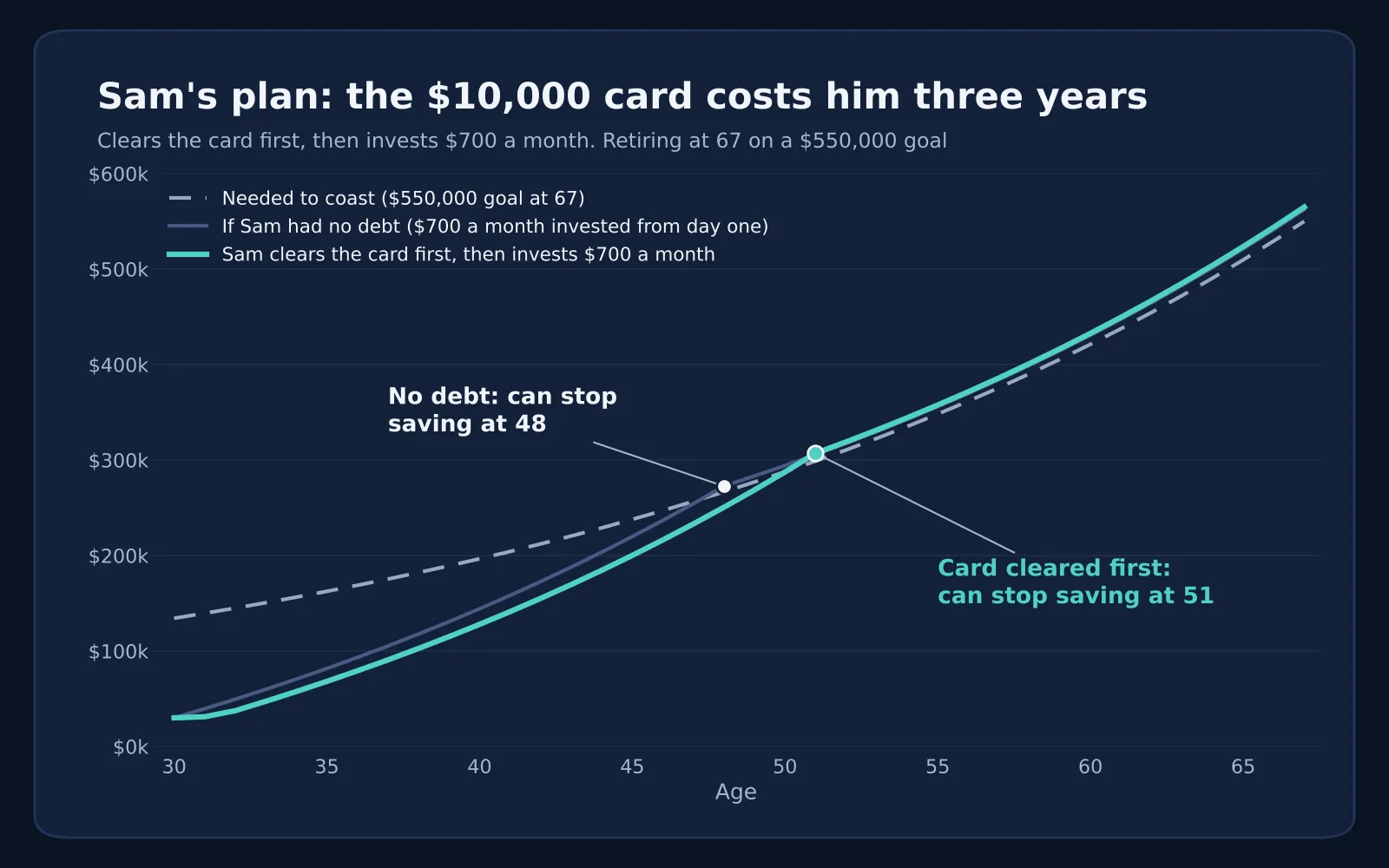
The $10,000 card costs Sam about three years of saving, whichever order he picks.
What the numbers really say
Two things stand out.
1. The debt costs the years, not the order. All three choices land on 51. With these figures, picking the “wrong” order does not ruin your plan. The card itself is what costs Sam three years. So if you feel guilty about paying debt instead of investing, you can let that go.
2. Card first still comes out ahead. At 40, Sam has $127,905 invested if he cleared the card first, and $123,593 if he paid $300 a month. That gap of about $4,300 is mostly the interest he did not pay. At 50, card first leaves him just $258 short of being able to stop saving a year earlier. The $300-a-month path is about $6,570 short.
And remember: that 51 for Choice 3 assumes the market gives a steady 7% every year. The 22% saved on the card is certain. If markets have a bad few years while Sam still carries the card, Choice 3 falls further behind. What a market crash does to your Coast FIRE plan shows how much early years matter.
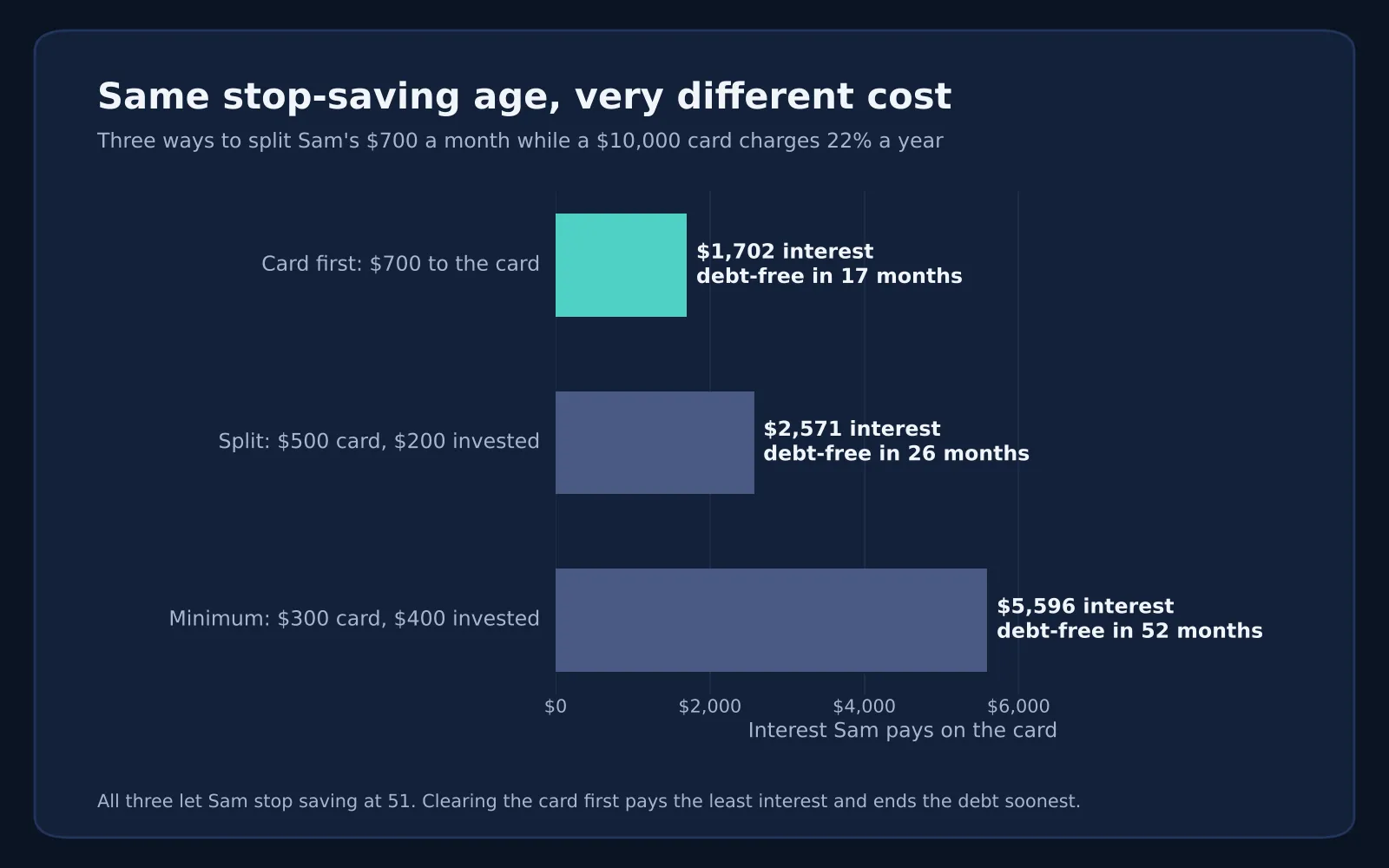
Same stop-saving age, but clearing the card first saves Sam almost $3,900 and nearly three years of debt.
What about cheaper debt?
Not all debt is a credit card. Here is a simple rule of thumb. It is a starting point, not a rule for everyone.
| Interest rate | Common examples | What many people do |
|---|---|---|
| Above about 8% | Credit cards, store cards, payday loans, many personal loans | Pay it off first, as fast as you can |
| About 4% to 8% | Many car loans | A close call: split, or lean towards paying it off |
| Below about 4% | Some mortgages and student loans | Pay as agreed, and invest the rest |
For a sense of where rates sit, the same Federal Reserve report shows an average of 11.90% on 24-month personal loans and 7.54% on 60-month new car loans in August 2026. Your own rate is what counts, so check your statements.
A few things can tip the balance either way:
- Free money from your employer. If your employer adds to your pension or retirement plan when you pay in, that match is usually worth more than paying any debt early. Keep getting it.
- Taxes. Some countries give tax relief on retirement saving, and some on certain loan interest. This can change the sums. The calculator’s numbers are before tax.
- Peace of mind. Being debt-free has a value the maths cannot show. If low-rate debt keeps you awake, paying it off is a fair choice.

The Coast FIRE twist: your bills decide when you can coast
Here is the part most “debt or invest” guides miss.
Coast FIRE does not mean you stop working. It means you stop saving for retirement and only need to earn enough to cover your bills. Many people use that freedom to work fewer hours or take a lower-paid job they enjoy. Coast FIRE, part-time work and career breaks looks at this in detail.
Debt payments are bills. Say Sam reaches his Coast FIRE number at 51 but still has a $350-a-month car loan. He now needs $4,200 a year more income just to coast. If the loan is gone, his part-time job can be that much smaller.
So clearing debt does two jobs: it frees money to invest now, and lowers the income you need later. The Barista FIRE calculator can show what part-time income would cover your costs.
A simple order to follow
This order works for many people. Your own situation may differ.
- Keep paying at least the minimum on every debt. Missed payments add fees and can hurt your credit record.
- Get any free money from your employer by paying in enough to get the full match.
- Save a small starter cash buffer, around one month of essential bills, so a surprise does not go straight onto a card. Emergency fund first or Coast FIRE first? shows why.
- Clear expensive debt, highest interest rate first. Once a debt is gone, move its payment to the next one.
- Build your cash buffer up to three to six months of essential bills.
- Invest towards Coast FIRE, and pay cheap debt as agreed.
- Do not take on new expensive debt. That is the one move that undoes all of the above.
Debt or invest: questions people ask
Should I pay off my student loans or invest? It depends on the rate. Low-rate loans are often fine to pay as agreed while you invest. Rules for student loans vary a lot by country, so check how yours work before paying extra.
Should I pay off my mortgage early or invest? Many people with a low mortgage rate invest instead. Should your home count towards Coast FIRE? looks at the home side of your plan.
Does debt change my Coast FIRE number? No. Your number depends on what you will spend in retirement. Debt changes how much you can invest each month, and so the age you get there. Plan to have debts paid off before you retire, or include their payments in your retirement spending.
What if we are a couple? Use your household spare money and combined debts. Coast FIRE for couples shows how to enter joint figures.
Every setting in the calculator is explained on the methodology page.
Work out your own number
Debt and investing are not enemies. Clearing expensive debt is often the fastest route to Coast FIRE, because it frees up every month after it.
Find your Coast FIRE number. It works for singles and couples, includes pensions, and shows every step of the maths with your own figures. Try it twice: once with your monthly saving as it is now, and once with your debt payments added on top, as they will be when the debt is gone. The gap shows you what being debt-free is worth.
This article is for education, not financial advice. All figures are in today’s money and do not include taxes or fees.
What is your Coast FIRE number?
Find the age you can stop saving for retirement. Free, no sign-up, and your numbers stay on your device.
Find your own Coast FIRE numberPhotos: Vitaly Gariev, Mikhail Nilov, Andrea Piacquadio on Unsplash.