What to do after Coast FIRE: you reached it, now what?
By Gourav Boruah · October 26, 2026 · 9 min read

Reaching Coast FIRE means you can stop saving for retirement. It does not mean you have to. So what to do after Coast FIRE? The best first move is to test your number with tougher assumptions, decide how much safety margin you want, and only then choose what to do with the money you no longer need to save. For many people, a few more years of lighter saving turns a thin margin into a comfortable one.
Want your own number first? Use the Coast FIRE calculator. It takes a minute and nothing is sent anywhere.
If you need a refresher, what Coast FIRE is covers the basics. In short: Coast FIRE is the point where the money you already have can grow into your full retirement pot on its own, without any more saving.
What reaching Coast FIRE does and does not mean
It is easy to read “you’ve reached Coast FIRE” as “you’re done”. Here is what it really means:
- You can stop saving for retirement. If growth and your plans turn out as assumed, your pot will reach what you need by your retirement age.
- You still need to pay for today. Coast FIRE does not cover your rent, food or bills before retirement. You still need an income for those.
- Your number is an estimate, not a promise. It rests on guesses about growth, inflation, your spending and your pension. If one of them changes, so does your number.
So the real question is not “can I stop?” It is “how sure do I want to be before I stop?”
A worked example: Daniel at 40
Meet Daniel. He is 40, has $240,000 invested for retirement and has been saving $1,000 a month. He thinks he will want to spend $45,000 a year in retirement, in today’s money. He plans to retire at 67 and expects a state pension (or Social Security) of about $20,000 a year from then.
He uses the calculator’s defaults: 7% growth, 3% inflation and a 4% withdrawal rate. The withdrawal rate is the share of the pot you take out each year in retirement.
Step 1: The pot he needs at 67. ($45,000 − $20,000) ÷ 0.04 = $625,000.
Step 2: Real growth. (1 + 0.07) ÷ (1 + 0.03) − 1 = 3.88% a year. That is growth after inflation. Why 7% growth is not really 7% explains this.
Step 3: How much $1 grows to in 27 years. 1.0388 to the power of 27 = about 2.797.
Step 4: His Coast FIRE number today. $625,000 ÷ 2.797 = about $223,400 (the calculator’s exact figure is $223,420.53).
Daniel has $240,000, so he is at 107.4% of his Coast FIRE number. He has made it. If he stopped saving today and nothing else changed, his money would grow to about $671,379.65 by 67, a little more than the $625,000 he needs.
Step 1: Test your number with less friendly numbers
Before Daniel stops saving, he tries one tougher assumption: growth of 6% a year instead of 7%. Nobody knows what markets will do over 27 years, so this is a sensible test, not a forecast.
At 6% growth, his Coast FIRE number today jumps to $287,890.09. His $240,000 is now only 83.4% of the way there. If he stopped saving now, he would reach about $521,032.17 at 67. That is about $103,967.83 short.
One percentage point of growth turned “done” into “not quite”. This is why the first thing to do after reaching Coast FIRE is to run the calculator again with a lower growth rate, and perhaps a 3.5% withdrawal rate too. The 4% rule explained shows why some people prefer 3.5%.
Step 2: Choose how big a safety margin you want
Daniel looks at three choices. All numbers are his pot at 67, in today’s money.
| Choice | Pot at 67 (7% growth) | Share of $625,000 | Pot at 67 (6% growth) | Share of $625,000 |
|---|---|---|---|---|
| Stop saving now, at 40 | $671,379.65 | 107.4% | $521,032.17 | 83.4% |
| Save $500 a month until 45 | $746,346.41 | 119.4% | $580,835.66 | 92.9% |
| Keep saving $1,000 a month until 45 | $821,313.17 | 131.4% | $640,639.15 | 102.5% |
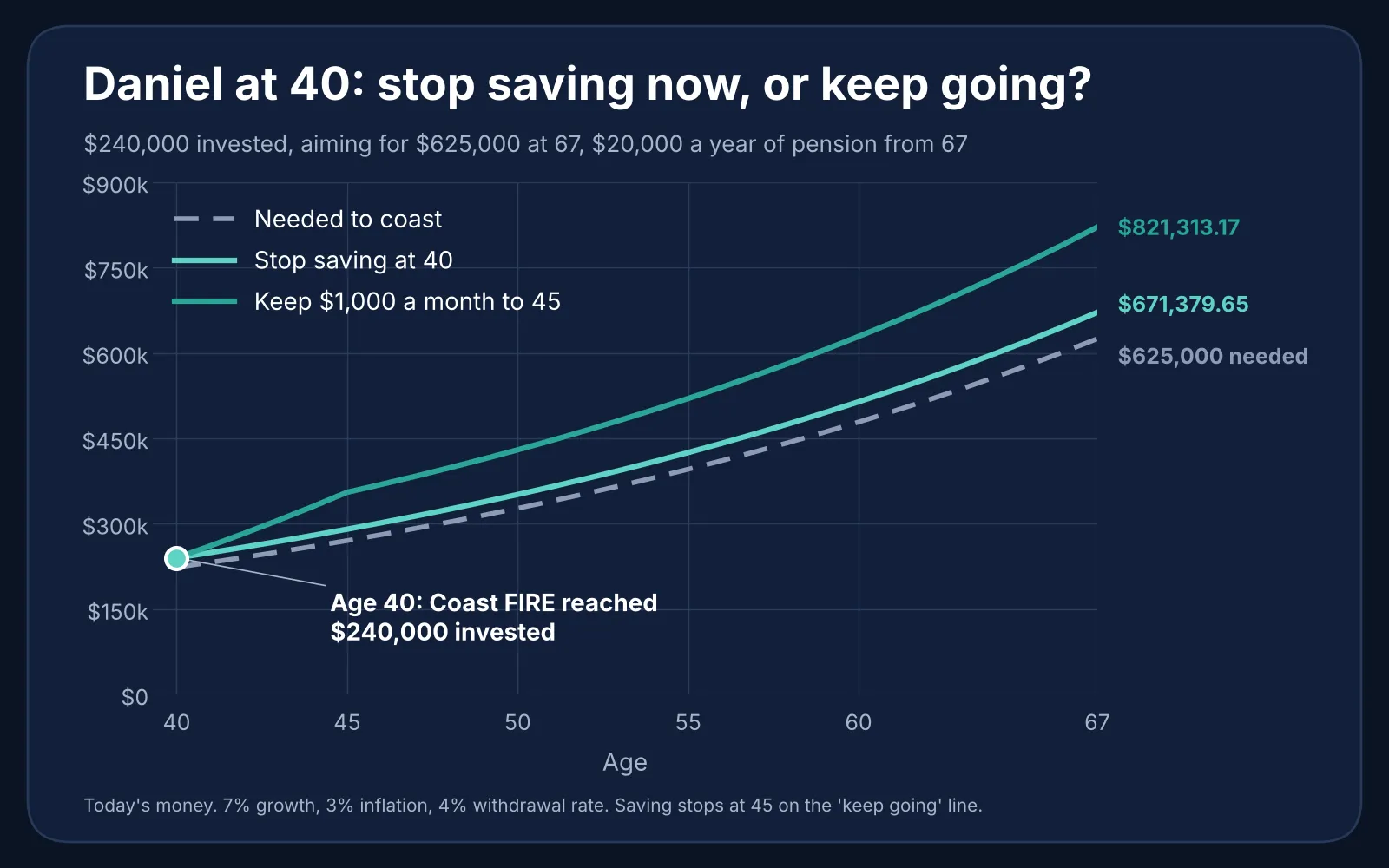
Stopping at 40 (light teal) still clears the amount needed to coast (dashed). Five more years of saving (dark teal) leaves a much bigger cushion.
Five more years at his normal $1,000 a month means he would still reach his full pot at 67 even if growth averaged 6%. Halving his saving to $500 a month gets him most of the way there, and frees up $500 a month for life today.
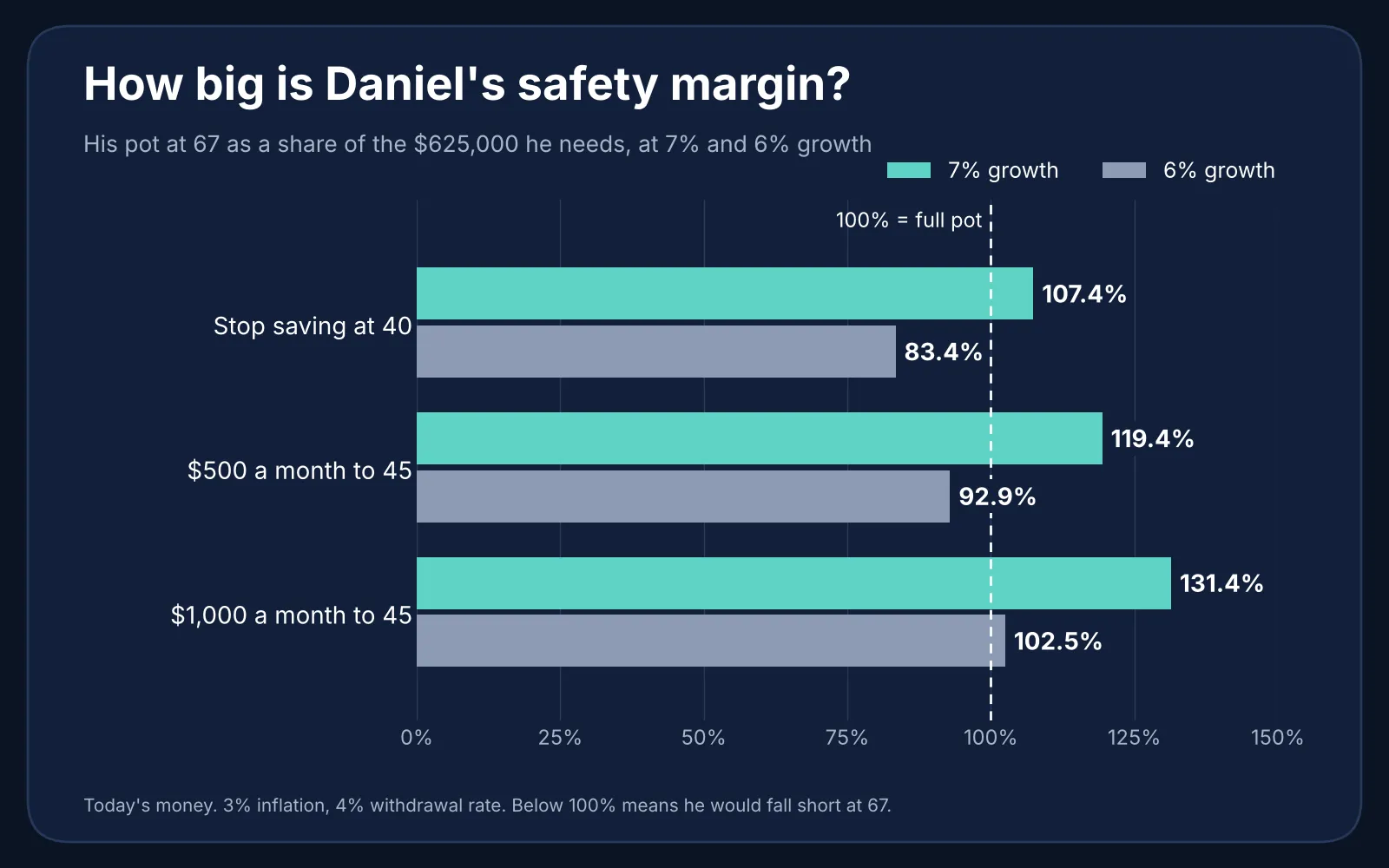
Above 100% means he reaches his full pot by 67. Only the “keep saving to 45” choice clears 100% at 6% growth.
There is no right answer here. Some people stop as soon as they reach 100%. Others like to reach 120% or 130% first. The point is to choose on purpose, knowing what each choice buys you.
Why your percentage stays flat once you stop
Here is something that surprises people. If Daniel stops saving at 40 and growth matches the plan exactly, he stays at 107.4% of his Coast FIRE number every single year. At 50, he would have about $351,298.89 and need about $327,030.77: still 107.4%.
That is because both numbers grow at the same rate. His money grows by 3.88% a year after inflation, and so does the amount he needs to be on track. So once you stop saving, your margin does not get bigger by itself. It only moves when something changes: growth is better or worse than assumed, or your spending or pension plans change.
This makes a yearly check-in easy. If your percentage has dropped, something has gone against you, and you can react early.
Step 3: Decide what to do with the money you no longer need to save
Once Daniel picks his safety margin, the money he was putting into retirement each month becomes free. Some common choices:
- Spend more on life now. Travel, time with family, a hobby you have put off. This is a big part of why people aim for Coast FIRE in the first place.
- Work less. You only need to earn enough to cover today. You might drop a day a week, take a lower-paid job you enjoy, or take a break. The Barista FIRE calculator shows how part-time work and a smaller pot fit together, and Coast FIRE vs Barista FIRE vs Fat FIRE compares the paths.
- Save for other goals. A home, a child’s education, a bigger emergency fund, or paying off expensive debt.
- Keep saving for retirement anyway. Extra money now could let you retire earlier than planned, or give you more room if things go wrong.

Many people do a mix. For Daniel, saving $500 a month until 45 and spending the other $500 is one middle path. Nothing here is a recommendation. It depends on your job, your health, your family and how much uncertainty you can live with.
What can knock you off course
Reaching Coast FIRE once does not mean you stay there. Four things move people back below 100%:
Your spending plans grow. If Daniel decides he will want $50,000 a year instead of $45,000, the pot he needs rises to $750,000 and his Coast FIRE number today rises to $268,104.64. He drops to 89.5%. Saving $1,000 a month again would get him back on track at 43.
Growth is lower than assumed. As above, 6% instead of 7% drops him to 83.4%.
Your pension turns out smaller. Every $1,000 a year less pension means $25,000 more pot at a 4% withdrawal rate. It is worth checking your official estimate: in the US, your Social Security Statement; in the UK, a State Pension forecast. Coast FIRE with a pension shows how to count one safely.
Markets fall hard. A big drop can push you below your number for a while. The longer you have until retirement, the more time there is to recover, but there is no guarantee.
None of these is a disaster if you catch it early. The fix is usually a few more years of saving, a slightly later retirement, or a lower spending plan.
Your yearly Coast FIRE check-in
Once a year, perhaps on your birthday, and any time your life changes (a new job, a move, a partner or children), do this:
- Add up everything you have invested for retirement.
- Check your expected pension on your government’s or employer’s official pages.
- Re-think your retirement spending in today’s money. Has your life changed?
- Enter the new figures in the calculator and note your percentage.
- Run it again at 6% growth to see your margin in a weaker market.
- Decide on your rule in advance. For example: “If I drop below 100%, I go back to saving until I am above it again.”
That last step matters most. Deciding what you will do before something goes wrong makes it much easier to act calmly when it does.
What to do after Coast FIRE: questions people often ask
Should I stop contributing to my retirement accounts after Coast FIRE? You can, but you do not have to. Many people keep at least some saving going for a few years to build a margin, as Daniel’s table shows. This article cannot tell you what is right for you.
What about my employer’s matching contribution? If your employer adds money when you contribute, stopping your own saving may mean losing that extra money too. Many people keep contributing at least enough to get it. Check your own workplace plan’s rules.
Can I quit my job once I reach Coast FIRE? Only if you have another way to pay for today until retirement. Coast FIRE covers your retirement pot, not your living costs before then.
I’m close but not quite there. What now? Keep saving and check again in a year. If you are 40 or older, Coast FIRE at 40 or 45 walks through the levers that help most.
Every setting is explained on the methodology page.
Work out your own number
Reaching Coast FIRE is a real milestone. The next step is to make it sturdy: test it with less friendly numbers, choose your safety margin, and check in once a year.
Find your Coast FIRE number. It works for singles and couples, includes pensions, and shows every step of the maths with your own figures.
This article is for education, not financial advice. All figures are in today’s money and do not include taxes or fees.
What is your Coast FIRE number?
Find the age you can stop saving for retirement. Free, no sign-up, and your numbers stay on your device.
Find your own Coast FIRE numberPhotos: Vanessa Garcia, Ketut Subiyanto on Unsplash.