What an extra $100 a month really does to your stop-saving age
By Gourav Boruah · November 4, 2026 · 8 min read

An extra $100 a month can move the age you can stop saving by years, not months. In our worked example, going from $500 to $600 a month lets Maya stop saving for retirement at 54 instead of 62, and she ends up putting in less money overall. The effect is biggest when you are only just on track, and it shrinks with every $100 after that.
Want your own number first? Use the Coast FIRE calculator. It takes a minute and nothing is sent anywhere.
New here? What is Coast FIRE explains the idea. In short: Coast FIRE is the point where the money you already have can grow into your full retirement pot on its own, so you can stop saving for retirement.
The “is it even worth it?” problem
Most people who save for retirement carry the same quiet worries:
- “I’m saving, but it never feels like enough.” You put money away every month and still have no idea if you are on track.
- “I can’t afford to double my saving.” Advice to “save 20% more” feels out of reach.
- “$100 won’t change anything.” It sounds too small to matter against a goal of half a million.
- “When can I stop saving for retirement?” Saving with no finish line is tiring.
The answer to all four is the same: put a finish line on it. Coast FIRE gives you one number, the age you can stop saving for retirement. Then you can see exactly what an extra $100 a month buys you, in years of your life.
Why a small amount can move the age so much
Picture two lines on a chart. One is your money, growing every year. The other is the amount you need to have invested to stop saving and coast. Your stop-saving age is where your money line crosses the other line.
When the two lines are far apart, they cross early and sharply. When you are only just on track, the lines run almost side by side for years, and they meet late. A small extra push each month lifts your line enough to meet the other one much sooner. That is why the first extra $100 often does far more than you would expect.
A worked example: Maya at 32
Meet Maya. She is 32 and has $40,000 invested for retirement. She saves $500 a month. She wants to retire at 67, expects to spend $42,000 a year, and expects a pension (or Social Security) of about $20,000 a year.
We use the calculator’s defaults: 7% growth, 3% inflation and a 4% withdrawal rate.
Step 1: The pot she needs at 67. ($42,000 − $20,000) ÷ 0.04 = $550,000. Saving more does not change this goal. The 4% rule explained shows where the 0.04 comes from.
Step 2: Her real growth rate. (1 + 0.07) ÷ (1 + 0.03) − 1 = 3.88% a year after inflation. Why 7% growth is not really 7% explains this step.
Step 3: How much $1 grows to in 35 years. 1.0388 to the power of 35 is about 3.794.
Step 4: Her Coast FIRE number today. $550,000 ÷ 3.794 = about $144,955. Her $40,000 is 27.6% of the way there.
Step 5: When she can stop saving. At $500 a month, her money passes the amount she needs at 62. She has about $455,481 by then, just above the $454,601 she needs at that age. She saves for 30 years.
At $600 a month, she gets there at 54. She has about $335,768, just above the $335,164 she needs. She saves for 22 years.
One extra $100 a month gives Maya 8 years without retirement saving. And here is the surprise: she pays in less in total. At $500 a month for 30 years she puts in $180,000. At $600 a month for 22 years she puts in $158,400. That is $21,600 less, because her money gets to do more of the work.
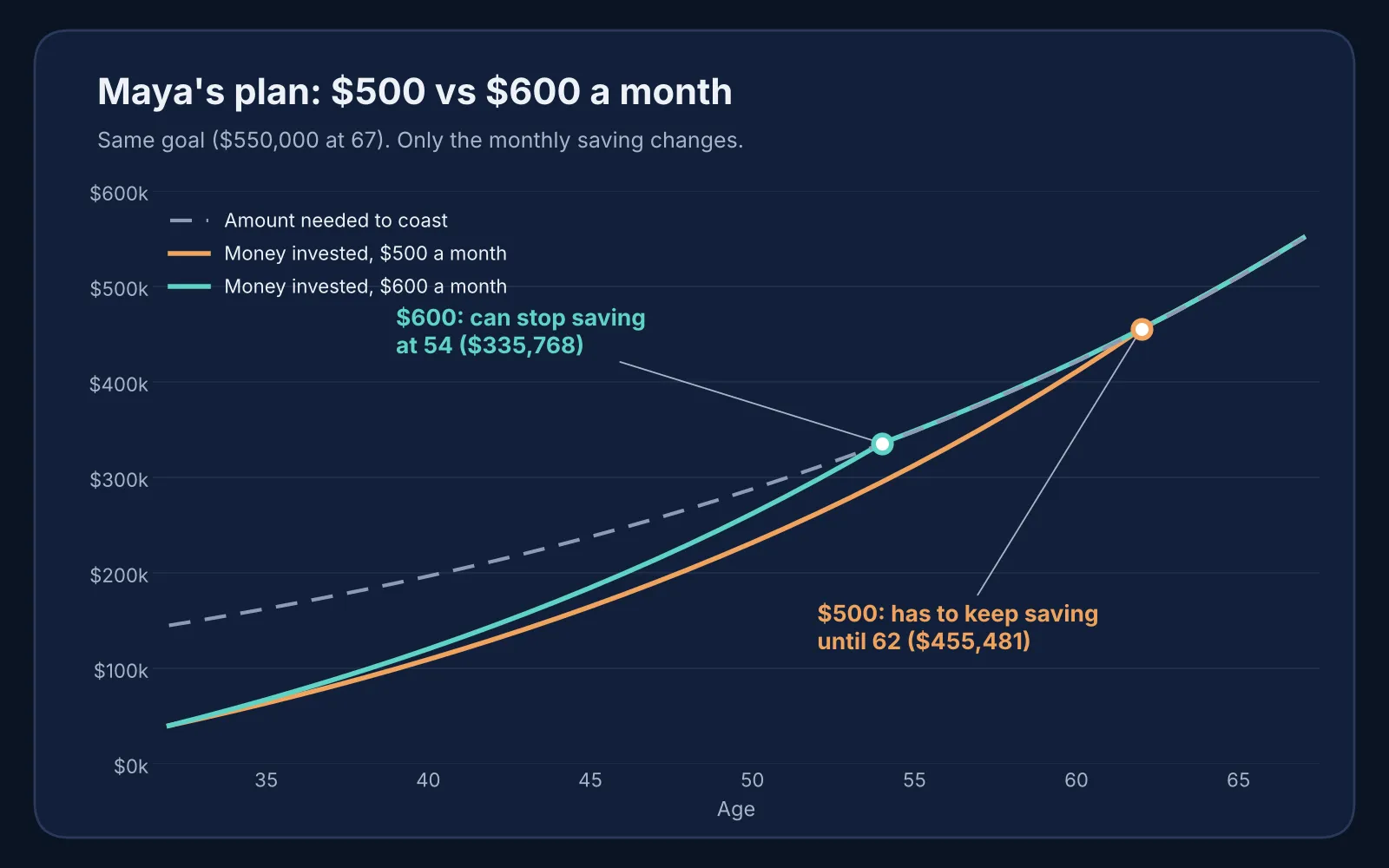
Both lines start at $40,000. The extra $100 a month moves the meeting point 8 years earlier.
Each extra $100 a month, side by side
We ran Maya’s plan at different monthly amounts, changing nothing else.
| Maya saves | Age she can stop saving | Years of saving | Total she puts in |
|---|---|---|---|
| $400 a month | Never: about $497,144 at 67, short of $550,000 | 35 | $168,000 |
| $500 a month | 62 | 30 | $180,000 |
| $600 a month | 54 | 22 | $158,400 |
| $700 a month | 50 | 18 | $151,200 |
| $800 a month | 47 | 15 | $144,000 |
| $900 a month | 45 | 13 | $140,400 |
| $1,000 a month | 43 | 11 | $132,000 |
Look at the gaps. The first extra $100 saves 8 years. The next saves 4, then 3, then 2, then 2. Each $100 still helps, but less than the one before. This is why a small first step is so powerful for someone who is only just on track.
It works the other way too. Drop from $500 to $400 a month and Maya never reaches Coast FIRE. She saves every month until 67 and is still about $52,856 short.
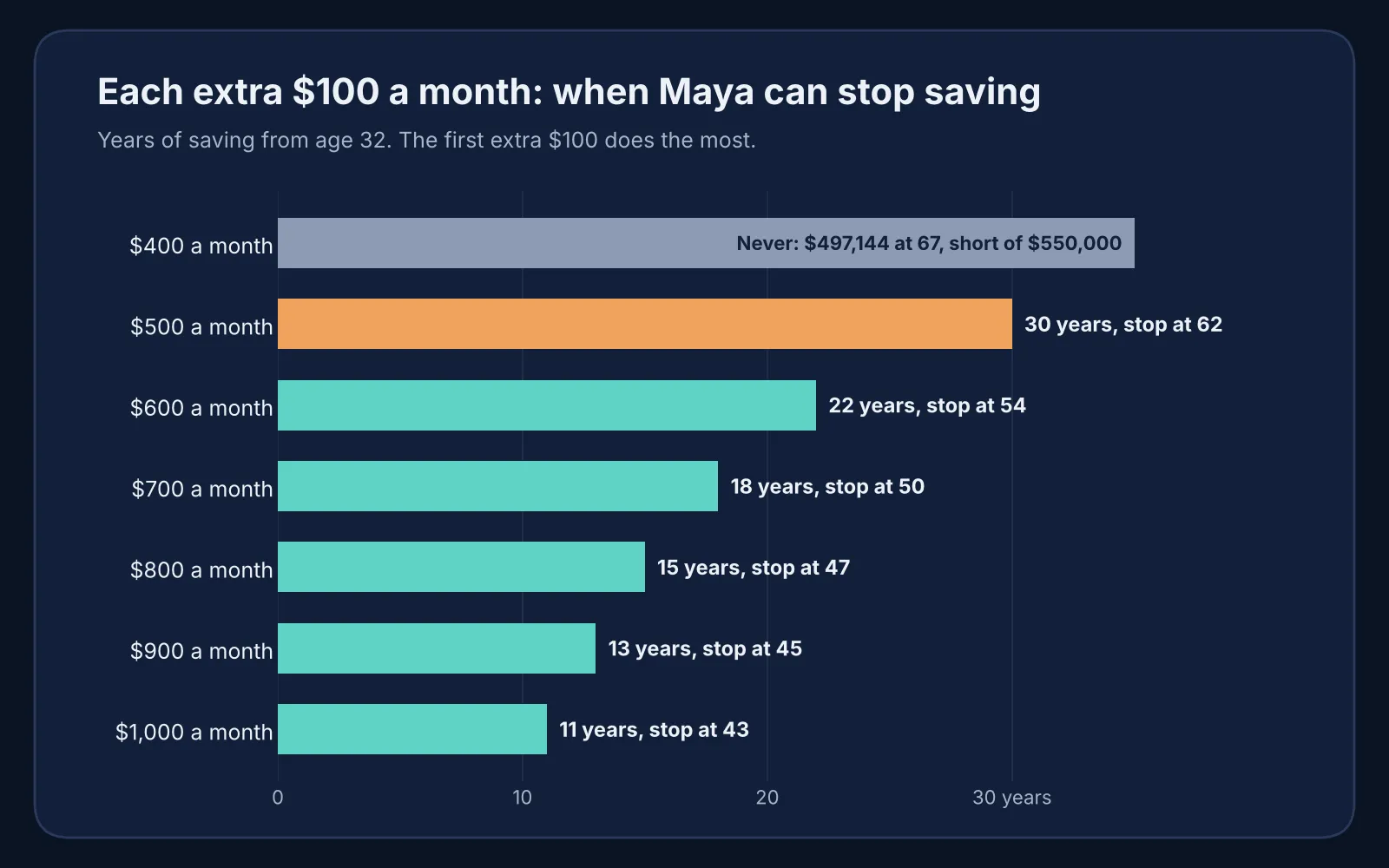
The first extra $100 does the most. After that, each $100 buys fewer years.
Start now, or wait until later?
Timing matters as much as the amount. We ran Maya’s plan three ways, with the extra $100 starting at different ages:
- Add $100 now, at 32: she can stop saving at 54.
- Add $100 at 40: she can stop at 57. By 40 she has about $109,310 invested, and the extra $100 has fewer years to grow.
- Add $100 at 50: she can stop at 60.
- Never add it: she saves until 62.
The same $100 a month is worth 8 years at 32, 5 years at 40 and only 2 years at 50. Early money has the most time to grow. Coast FIRE in your 20s explains why. If you are starting later, Coast FIRE starting at 40 shows what still works.

What $100 a month grows to on its own
Forget the rest of Maya’s plan for a moment. If she invested only $100 a month from 32 to 67, at 3.88% real growth, she would end up with about $86,343 in today’s money. She would have paid in $42,000. The other $44,343 is growth.
You may see much bigger numbers quoted for what it means to invest $100 a month. Those often leave inflation in, so the figures are in future dollars. The numbers on this site are always in today’s money, so you can compare them with prices you know. If you want to check any figure yourself, the US regulator’s free compound interest calculator lets you enter a monthly amount and a growth rate.
How to test an extra $100 in the calculator
This takes about two minutes:
- Open the calculator and fill in your age, savings, monthly saving, spending and pension.
- Write down the age it says you can stop saving.
- Add 100 to your monthly saving. Write down the new age.
- Add another 100 and look again. You will see your own version of Maya’s table.
- Find the step where the age stops moving much. That is often a sensible amount to aim for.
If your currency is not the dollar, use the same idea with a small round amount, such as £100, €100 or ₹5,000. The methodology page explains how the calculator works.
Where an extra $100 a month can come from
This is general education, not advice for your situation. A few common places people find a small monthly amount:
- Your next pay rise. Send part of it to your retirement saving before you get used to spending it.
- A finished payment. When a loan or a subscription ends, keep paying the same amount into your investments instead.
- A workplace match. If your employer adds money when you save more, check whether you are getting all of it.
- One regular cost. Look at a bill you pay every month and see if a cheaper option exists.
- Lower fees. Paying less in fees works like saving more. How a 1% fee changes your Coast FIRE number shows how much.
However you find it, set the increase to happen automatically on payday. Many workplace plans and investing apps let you increase retirement contributions with a single setting. Money you never see is easier to keep saving.

Extra $100 a month: questions people ask
Is $100 a month enough to make a difference? Often, yes. In Maya’s example it moves her stop-saving age from 62 to 54. The effect is largest when you are only just on track.
Why does the first $100 matter more than the next? Because it changes when your money line meets the “needed to coast” line. Once you are well ahead, extra money still helps, but it moves the meeting point by fewer years.
Should I save $100 more now or a lot more later? Earlier is usually stronger. The same $100 a month gave Maya 8 years back at 32 but only 2 years at 50.
What if we are a couple? Use your combined investments, saving and spending. Coast FIRE for couples shows how.
Work out your own number
You do not need a big change to make real progress. One small, steady step can bring your stop-saving age years closer, and the calculator shows you exactly how many.
Find your Coast FIRE number. It works for singles and couples, includes pensions, and shows every step of the maths with your own figures. Run it once with what you save today, then once with $100 more, and see how far your finish line moves.
This article is for education, not financial advice. All figures are in today’s money and do not include taxes or fees.
What is your Coast FIRE number?
Find the age you can stop saving for retirement. Free, no sign-up, and your numbers stay on your device.
Find your own Coast FIRE numberPhotos: Mikhail Nilov, cottonbro studio, Marcus Aurelius on Unsplash.