Index funds explained: the simple engine behind Coast FIRE
By Gourav Boruah · November 2, 2026 · 9 min read

An index fund is one fund that buys a small slice of every company in a market list, such as the 500 large US companies in the S&P 500. You do not pick winners. You own the whole market, at a low cost, and you get the market’s return. That is exactly the kind of steady, hands-off growth a Coast FIRE plan relies on.
Want your own number first? Use the Coast FIRE calculator. It takes a minute and nothing is sent anywhere.
New to the idea? What is Coast FIRE covers the basics. In short: Coast FIRE is the point where the money you already have can grow into your full retirement pot on its own, without any more saving.
The worry this solves
Many people put off investing for years. Not because they lack the money, but because of the questions:
- “Which shares should I buy?” There are thousands. Picking feels like gambling.
- “What if I choose wrong?” One bad pick could wipe out years of saving.
- “Do I need to watch the news every day?” That sounds like a second job.
- “Is my money even doing enough?” You save every month, but you have no idea if it will be enough, or when you can stop.
Index funds answer the first three. You do not pick, you cannot pick wrong in the way a stock picker can, and you do not need to watch anything. The calculator answers the fourth: it shows the amount you need and the age you can stop saving.

What is an index fund?
Think of a supermarket basket that holds one of everything on the shelf. If one item goes off, it hardly matters, because you have hundreds of others.
An index is a list of companies, chosen by a set rule. The S&P 500 lists 500 large US companies. Other indexes cover the whole US market, the UK, India, or almost every listed company in the world.
An index fund simply copies one of those lists. The US regulator’s investor bulletin on index funds describes it as a mutual fund or exchange-traded fund (ETF) that tries to track the returns of a market index. You cannot buy an index directly, so the fund does it for you. In the UK they are often called tracker funds.
How do index funds work?
Here is what happens when you put $100 into an index fund:
- Your money joins everyone else’s. The fund pools money from many investors.
- The fund buys the list. It buys the companies in its index, in the same proportions. Some funds hold every company; some hold a careful sample.
- Nobody is guessing. There is no star manager choosing shares, so the running costs can be low.
- You get the market’s return, minus a small fee. If the index rises 8% in a year, the fund rises a little under 8%. If the index falls, the fund falls too.
That small gap between the fund and its index is called tracking error. Fees and trading costs cause most of it. A good index fund keeps it tiny.
Why index funds suit Coast FIRE
Coast FIRE is a long game. You need your money to grow steadily for 20 or 30 years without you touching it. Index funds fit that job for three reasons.
1. You get the market’s return, which is what the plan assumes. The calculator’s default growth of 7% a year before inflation is a planning assumption for a broad mix of shares over the long run. It is not a promise. A fund that owns the whole market is the most direct way to aim for “whatever the market gives”.
2. Most fund managers who try to beat the market do not. In S&P Dow Jones Indices’ SPIVA U.S. Mid-Year 2026 scorecard, about 83% of US large-company funds did worse than the S&P 500 over the 10 years to 30 June 2026. Over 20 years it was about 93%. Some managers do win, but picking them in advance is hard.
3. Low costs leave more money growing. Every dollar you pay in fees is a dollar that stops compounding for you. Over decades, this matters more than almost anything else you control.
A worked example: Maya at 32
Meet Maya. She is 32, has $40,000 invested for retirement and puts $800 a month into a broad index fund. She wants to retire at 67, expects to spend $42,000 a year, and expects a pension (or Social Security) of about $20,000 a year.
We use the calculator’s defaults: 7% growth, 3% inflation and a 4% withdrawal rate.
Step 1: The pot she needs at 67. ($42,000 − $20,000) ÷ 0.04 = $550,000. The 4% rule explained shows where the 0.04 comes from.
Step 2: Real growth. (1 + 0.07) ÷ (1 + 0.03) − 1 = 3.88% a year. That is growth after inflation. Why 7% growth is not really 7% explains this step.
Step 3: How much $1 grows to in 35 years. 1.0388 to the power of 35 = about 3.794.
Step 4: Her Coast FIRE number today. $550,000 ÷ 3.794 = about $144,955.
Maya has $40,000, so she is 27.6% of the way there. If she keeps investing $800 a month, her money passes the amount she needs at 47. By then she has about $261,407, just above the $256,703 she needs at that age. From 47, she could stop saving for retirement and let the index fund carry her to $550,000 by 67.
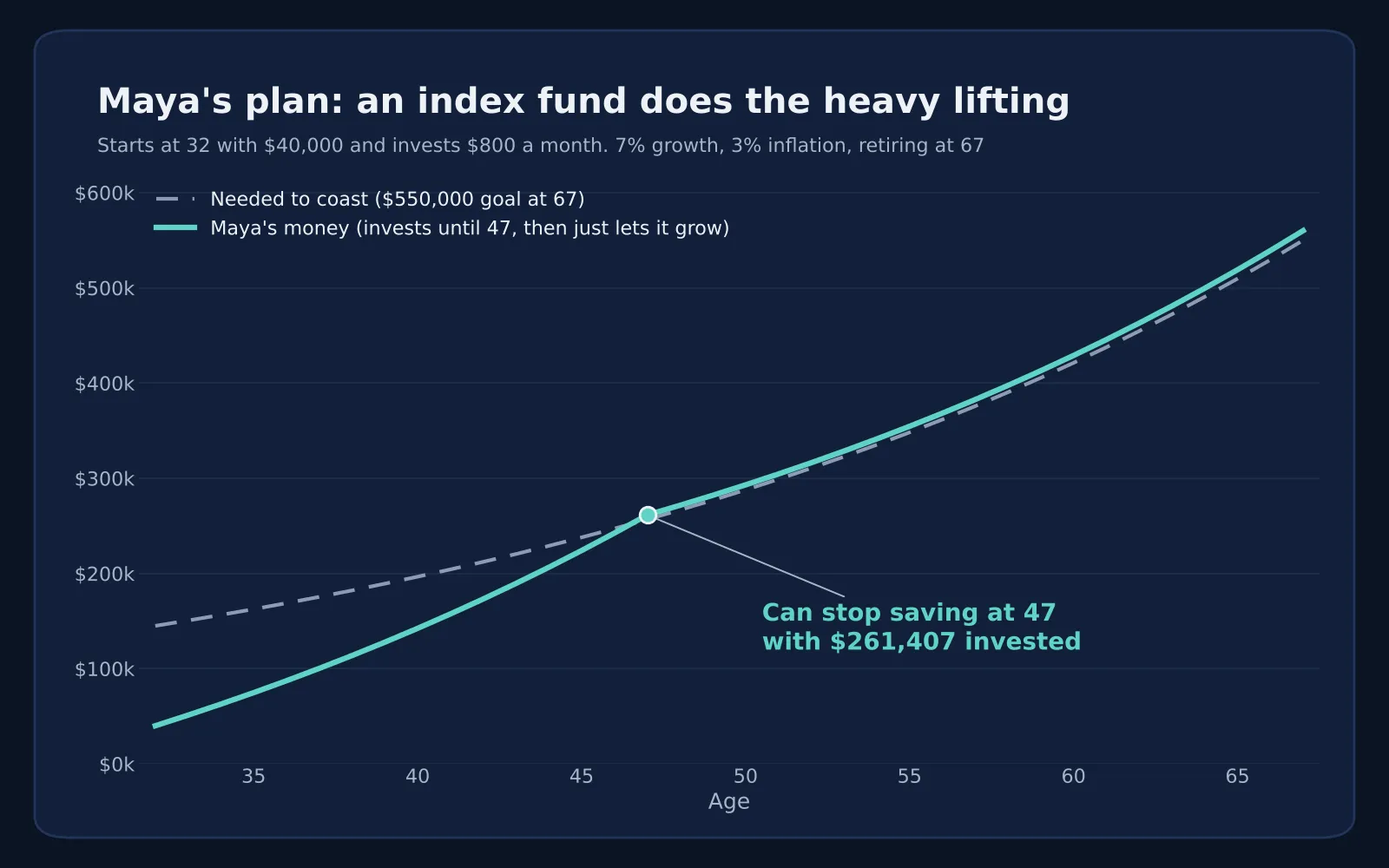
With 7% growth, Maya invests for 15 years and then lets her money do the rest.
What if your money trails the market?
This is the part most guides about index funds skip. What does it cost you if your money grows a bit slower than the market, year after year? That could happen with a high-fee fund, a fund that lags its index, or a habit of buying and selling at the wrong times.
We ran Maya’s plan again, changing only the growth rate.
| Maya’s growth before inflation | Real growth | Her Coast FIRE number at 32 | Age she can stop saving |
|---|---|---|---|
| 7% (the calculator’s default) | 3.88% | $144,955 | 47 |
| 6% (1 point behind) | 2.91% | $201,354 | 56 |
| 5% (2 points behind) | 1.94% | $280,569 | Not before 67 |
One point less growth a year moves her stop-saving age from 47 to 56. That is nine more years of putting in $800 every month. Two points less and she has to keep saving all the way to 67. She never gets to coast.
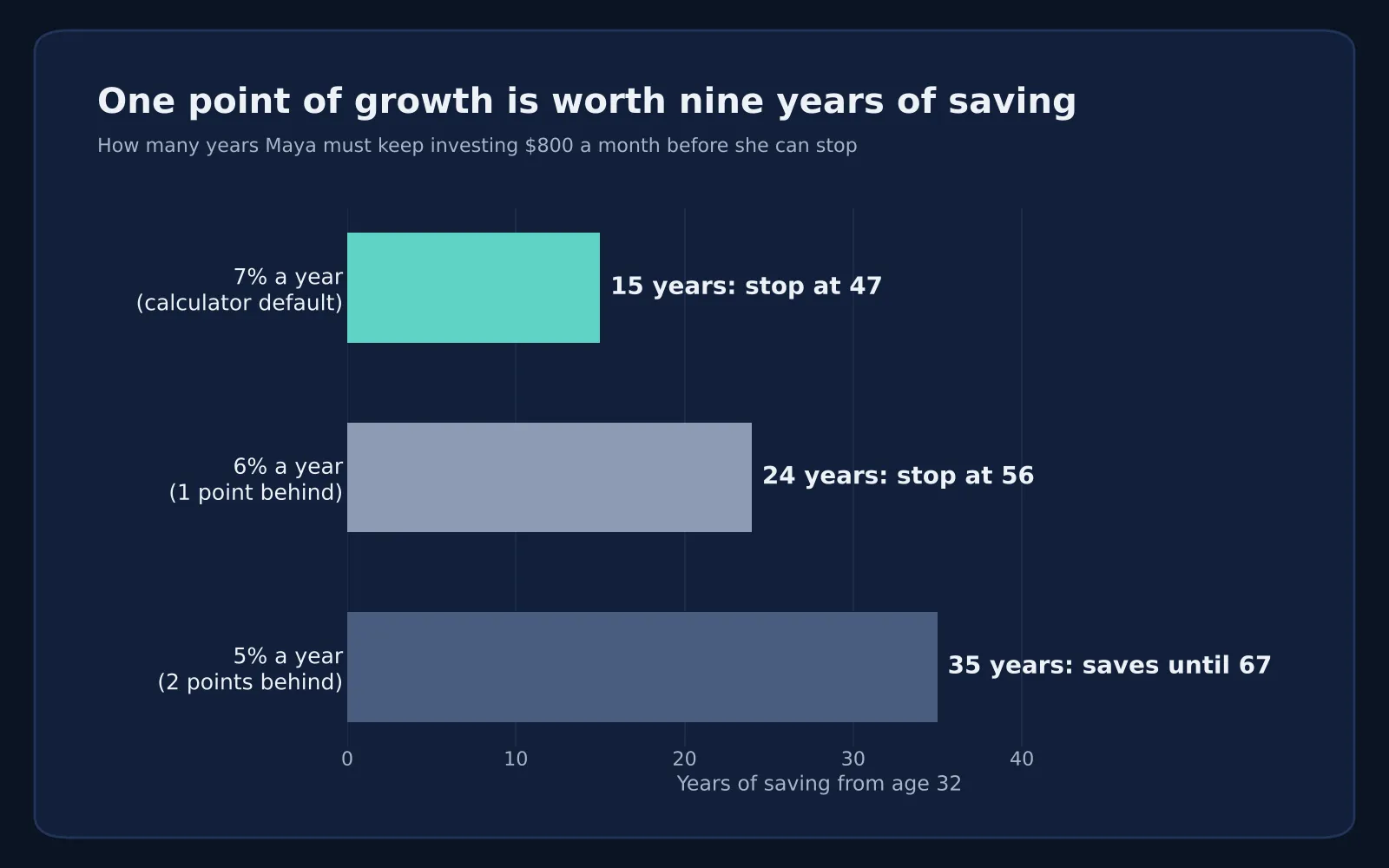
Same saver, same goal. Only the growth rate changes, and it changes everything.
This is why the boring choice is often the powerful one. A low-cost fund that simply matches the market keeps Maya’s plan on track. The calculator’s Plan section shows your own result at 5%, 7% and 9% growth, so you can see how much your plan depends on it. The methodology page explains how.
Are index funds safe?
Safe from picking the wrong company, mostly yes. One company going bust barely dents a fund that holds hundreds. Safe from falling in value, no.
When the whole market drops, an index fund drops with it. The SEC bulletin is clear that index funds carry the risks of the shares they hold. In a bad year, your balance can fall sharply, and it can take years to recover.
What helps is time. Coast FIRE plans run for decades, and the money you invest at 32 is not needed until 67. What a market crash does to your Coast FIRE plan shows what a crash does to your stop-saving age, and why the worst move is usually selling in a panic.
Money you need within a few years, like an emergency fund, should not sit in shares at all.
Index fund vs ETF
People often ask which is better. They are not really rivals. An ETF is a way of packaging a fund, and many index funds come as ETFs.
| Index mutual fund | Index ETF | |
|---|---|---|
| What it holds | A copy of an index | A copy of an index |
| How you buy it | From the fund company or a platform, at one price a day | On the stock exchange, through a broker, during the day |
| Minimum to start | Some have a minimum amount | Usually the price of one share, or less where part-shares are allowed |
| Good for Coast FIRE? | Yes | Yes |
Either can work. What matters more is what the fund tracks and what it costs.

A simple start you can do this week
This is general education, not advice for your situation. Rules and accounts differ by country.
- Work out your number first. Put your age, savings and spending into the calculator. Now you know what your money has to do.
- Use a tax-friendly retirement account if your country has one. For example a 401(k) or IRA in the US, an ISA or pension in the UK, or a TFSA or RRSP in Canada. The tax rules can matter as much as the fund.
- Look for a broad, low-cost index fund. “Broad” means it holds hundreds or thousands of companies. Check the yearly fee, often called the expense ratio or ongoing charge.
- Set up an automatic monthly payment. Same amount, same day, every month. This takes the decision out of your hands.
- Leave it alone. Check in once a month, not once a day. Do not sell when the news is scary.
- Re-run the calculator once or twice a year. Watch your stop-saving age come closer.
Index funds: questions people ask
Are index funds good for beginners? Many people start with them because there is only one decision to make: which index to follow. You do not need to research single companies.
Are index funds good for retirement? They are a common core for long-term retirement saving because they spread risk and keep costs low. How much you hold in shares versus safer assets is a personal choice that often changes as you get older.
How many index funds do I need? Some people use one fund that covers the whole world. Others use two or three. More funds do not mean more safety if they all hold the same companies.
What if we are a couple? Use your combined investments and saving. Coast FIRE for couples shows how.
Work out your own number
An index fund is the engine. Your Coast FIRE number is the destination. Once you know both, you can stop worrying about which shares to buy and start counting down to the age you can stop saving.
Find your Coast FIRE number. It works for singles and couples, includes pensions, and shows every step of the maths with your own figures. Try it at 7% growth, then at 6%. The gap shows you why low costs and staying invested matter so much.
This article is for education, not financial advice. All figures are in today’s money and do not include taxes or fees.
What is your Coast FIRE number?
Find the age you can stop saving for retirement. Free, no sign-up, and your numbers stay on your device.
Find your own Coast FIRE numberPhotos: Asad Photo Maldives, Antonius Ferret, Gustavo Fring on Unsplash.