Coast FIRE in the UK: the State Pension, ISAs and pensions
By Gourav Boruah · October 21, 2026 · 8 min read

Coast FIRE in the UK works the same way as anywhere else: once your investments can grow into your full retirement pot on their own, you can stop saving for retirement. What makes the UK different is the State Pension. A full one is worth over £12,500 a year in today’s money, and counting it properly can cut your Coast FIRE number by more than half.
Want your own number first? Use the Coast FIRE calculator. It takes a minute and nothing is sent anywhere.
If “Coast FIRE” is new to you, start with what Coast FIRE is.
The State Pension: the biggest number in your plan
The full new State Pension is £241.30 a week for the 2026 to 2027 tax year, according to GOV.UK. Over 52 weeks that is £12,547.60 a year.
Three things decide what you will get:
- Your National Insurance record. You usually need 35 qualifying years for the full amount and at least 10 years to get anything, as GOV.UK’s State Pension guide explains. Years of work count, and so can some years when you get National Insurance credits, for example while claiming certain benefits.
- Your State Pension age. It is rising from 66 to 67 between 2026 and 2028. Under current law it then rises to 68 between 2044 and 2046, which affects anyone born on or after 6 April 1977, according to the State Pension age timetable. A third review of the age is under way, so it could change again. Check your own State Pension age rather than guessing.
- Future rules. Nobody knows how the State Pension will rise in the decades ahead. Planning with today’s amount, in today’s money, is a sensible middle path.
Why it matters so much: at a 4% withdrawal rate, every £1 of yearly pension saves you £25 in the pot. One full State Pension does the work of about £313,690 of savings (£12,547.60 × 25). Two of them, for a couple, do the work of over £600,000.
You can get a free forecast of your own State Pension on GOV.UK. That figure is the one to put in the calculator’s pension box. Coast FIRE with a pension shows how to count it safely.

A worked example: Sophie and James at 32
Meet Sophie and James. They are both 32 and live in Leeds. Between them they have £45,000 invested, counting their workplace pensions and stocks and shares ISAs. Each month £700 goes in, counting their own pension payments, their employers’ payments and tax relief.
They want to spend £38,000 a year in retirement, in today’s money. Both expect a full State Pension, so together they will get £25,095.20 a year. They were both born after April 1978, so under current law their State Pension age is 68. They plan to retire then.
They use the calculator’s defaults: 7% growth, 3% inflation and a 4% withdrawal rate.
Step 1: The pot they need at 68. (£38,000 − £25,095.20) ÷ 0.04 = £322,620.
Step 2: Real growth. (1 + 0.07) ÷ (1 + 0.03) − 1 = 3.88% a year. That is how much faster their money grows than prices.
Step 3: How much £1 grows to in 36 years. 1.0388 to the power of 36 = about 3.94. Every pound they have today becomes about £3.94 by 68, in today’s money.
Step 4: Their Coast FIRE number today. £322,620 ÷ 3.94 = about £81,850 (the calculator’s exact figure is £81,849.38).
With £45,000 invested, they are already 55% of the way there. If they keep saving £700 a month, they catch up at 37, with £99,834.70 invested. After that they can stop saving for retirement, and growth alone takes their money to about £325,255.52 by 68.
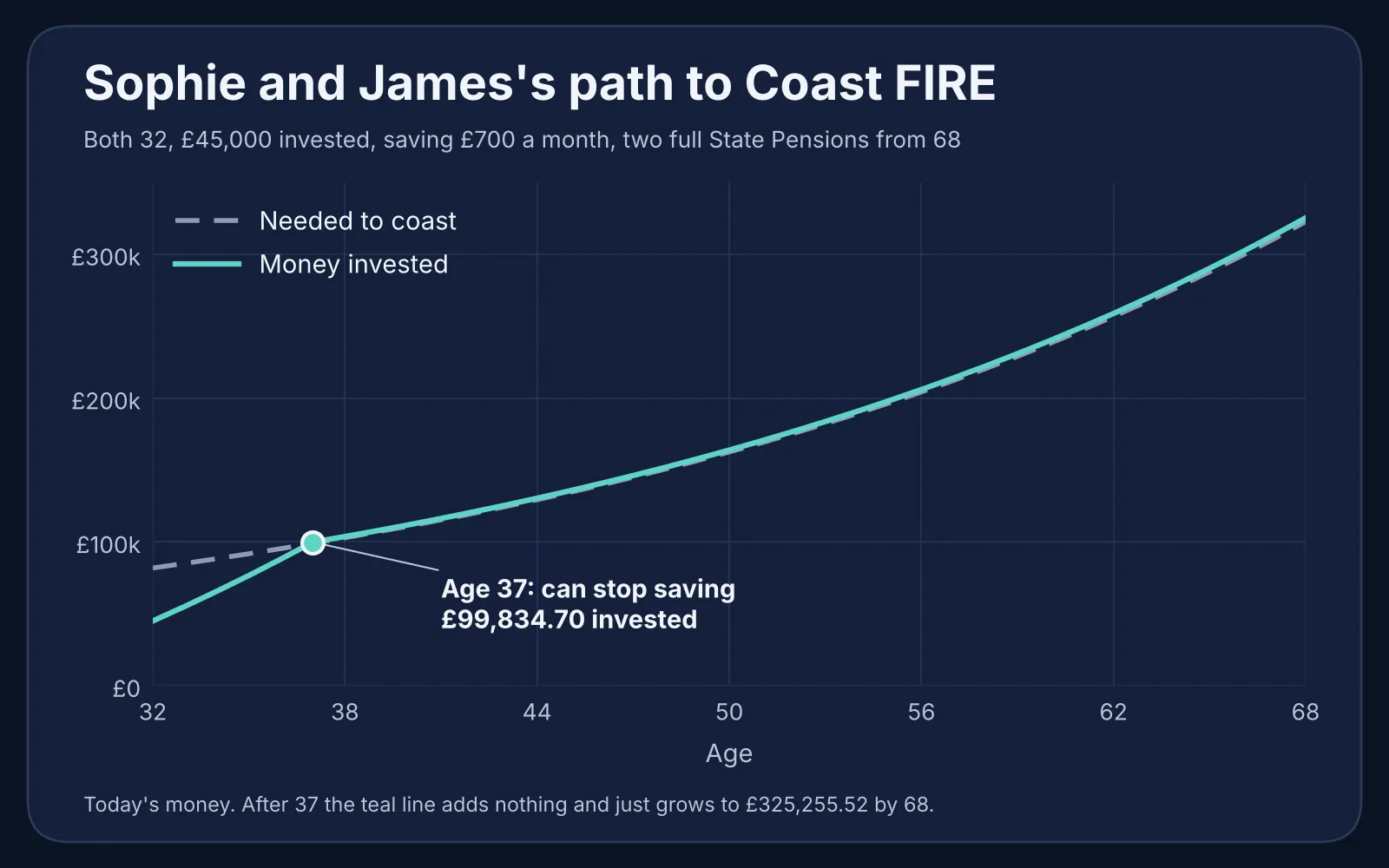
Their money invested (teal) meets the amount needed to coast (dashed) at 37. From then on, they add nothing more for retirement.
What if the State Pension is smaller?
Now the same couple, with everything else unchanged, but less State Pension counted.
| State Pension counted | Pot needed at 68 | Coast FIRE number today | They can stop saving at |
|---|---|---|---|
| Two full (£25,095.20 a year) | £322,620 | £81,849.38 | 37 |
| One full (£12,547.60 a year) | £636,310 | £161,433.19 | 53 |
| None | £950,000 | £241,017.01 | Not by 68 |
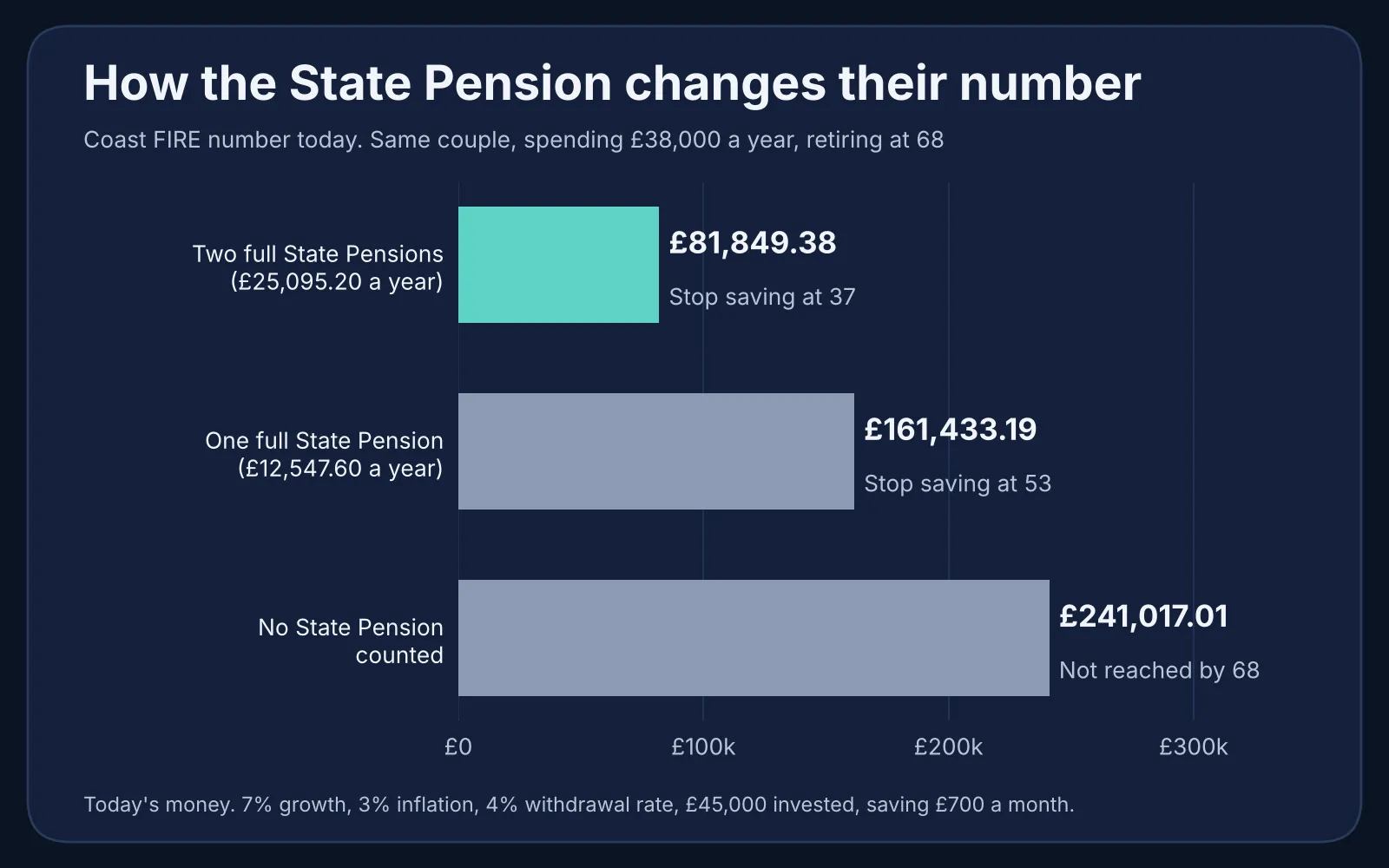
Each full State Pension knocks about £80,000 off their Coast FIRE number today.
With no State Pension counted, they would still be short at 68, even saving all the way: about £813,648 against the £950,000 they need. That is why a gap in your National Insurance record is worth checking early. You may be able to fill some gaps with voluntary National Insurance payments.
Two more checks they can run:
- A careful withdrawal rate. At 3.5% instead of 4%, they would need £368,708.57 at 68, their Coast FIRE number would be £93,542.15, and they could stop saving at 39 instead of 37. The 4% rule explained shows why some people prefer 3.5%.
- A different monthly saving. At £500 a month they would stop at 40. At £900 a month, 36.
ISAs and pensions: what counts as “money invested”
The calculator has one box for money invested and one for monthly saving. Here is how the common UK accounts fit in.

- Workplace pension. Count the whole balance. In your monthly saving, include your payments, your employer’s payments and tax relief. Under automatic enrolment the usual minimum is 8% of qualifying earnings, with at least 3% from your employer, according to GOV.UK. Many employers pay more.
- Personal pension or SIPP. Count the balance. Pension payments usually get tax relief, up to an annual allowance of £60,000 and no more than your earnings for the year, as GOV.UK explains. Most people are nowhere near that limit.
- Stocks and shares ISA. Count what you hold for retirement. You can put in up to £20,000 a year across all your ISAs, and you pay no tax on the growth or when you take money out.
- Cash ISA and savings. Count only money meant for retirement, not your emergency fund. From 6 April 2027, people under 65 will be able to put only £12,000 a year into cash ISAs, within the same £20,000 total, according to GOV.UK.
- Lifetime ISA. You must make your first payment before 40, and you can pay in up to £4,000 a year until 50. The government adds 25%, up to £1,000 a year. If you take money out before 60 for anything other than a first home, there is a 25% charge, as GOV.UK explains. Count it only if it is truly for retirement.
Pension or ISA: when can you reach the money?
For Coast FIRE the question is not just how much, but when you can use it.
- Private pensions can usually be reached from 55. That rises to 57 from 6 April 2028, according to GOV.UK. You can usually take 25% tax-free, up to £268,275, as GOV.UK explains. The rest is taxed as income.
- ISAs can be reached at any age, with no tax.
- The State Pension starts at your State Pension age, not before.
If you want to stop work before your State Pension starts, you need money to cover those “bridge” years, and ISAs are often how people do it. The calculator assumes your pension starts the day you retire. So if you plan to retire before your State Pension age, lower the pension figure to stay safe, or set your retirement age to your State Pension age, as Sophie and James did.
Tax and inflation: two notes for the UK
Tax. Pension income is usually taxed, including the State Pension, once your total income is above your Personal Allowance, as GOV.UK explains. ISA withdrawals are tax-free. The calculator works before tax, so if most of your pot will be in pensions, add a little to your yearly spending to cover tax.
Inflation. The Bank of England aims to keep inflation at 2%, a target set by the government, as the Bank of England explains. The calculator’s 3% default is a little more careful than that. What really matters is the gap between growth and inflation, not either figure alone. Why 7% growth is not really 7% explains this.
Questions people in the UK often ask
Should I count the State Pension at all? Most people do, because leaving it out makes the plan far harder than it needs to be. If you worry about future changes, count part of it, or only the years you have already built up.
Is a final salary pension different? Yes. A defined benefit pension pays a set income, so it belongs in the pension box, not in money invested. Use the yearly figure from your latest statement.
We are a couple. Does each of us get a State Pension? Yes. The new State Pension is based on each person’s own record. Coast FIRE for couples shows how to plan together, including different ages.
Does my house count? Most people leave their home out of money invested, because they still need somewhere to live. Rent from a property you will keep can go in the pension box, after costs.
Five steps to work out yours today
- Get your State Pension forecast from GOV.UK and check your State Pension age.
- Add up your workplace pensions, personal pensions and retirement ISAs. That is your money invested.
- Add up what goes in each month, including your employer’s payments and tax relief.
- Open the calculator, choose United Kingdom, and enter your figures with your State Pension in the pension box.
- Run it again with half your State Pension, and again at a 3.5% withdrawal rate. If the stop-saving ages are close, your plan is sturdy.
Every setting is explained on the methodology page.
Work out your own number
Your number depends on your spending, your State Pension and any other pensions, and the gap between growth and inflation you choose. Seeing two or three versions side by side tells you more than any single answer.
Find your Coast FIRE number. It works for singles and couples, includes pensions, and shows every step of the maths with your own figures in pounds.
This article is for education, not financial advice. All figures are in today’s money and do not include taxes or fees.
What is your Coast FIRE number?
Find the age you can stop saving for retirement. Free, no sign-up, and your numbers stay on your device.
Find your own Coast FIRE numberPhotos: Alexander Mass, Joshua Woroniecki, Kampus Production on Unsplash.