Coast FIRE in India: working it out in rupees and lakhs (EPF, NPS, higher inflation)
By Gourav Boruah · October 20, 2026 · 9 min read

Coast FIRE works in India exactly as it does anywhere else: once your investments are big enough to grow into your full retirement pot on their own, you can stop saving for retirement. What changes in India is the inflation figure. India’s inflation target is twice the US and UK target, so it makes sense to plan with a higher number, and the gap between growth and inflation becomes the figure that decides everything.
Want your own number first? Use the Coast FIRE calculator. It takes a minute and nothing is sent anywhere.
Lakhs, crores and the calculator
A quick note on units, because most Coast FIRE guides are written in dollars.
- 1 lakh = ₹1,00,000 (one hundred thousand).
- 1 crore = ₹1,00,00,000 (one hundred lakh, or ten million).
Choose India in the calculator’s country menu and every amount is shown in rupees, with Indian digit grouping like ₹64,18,448. Two habits help:
- Enter yearly amounts. If your family spends ₹75,000 a month, enter ₹9,00,000 a year.
- Use today’s money. Write what you would spend at today’s prices. The calculator handles future prices for you.
If “Coast FIRE” is new to you, start with what Coast FIRE is.
Why inflation matters more in India
Inflation is the slow rise in prices. The calculator starts with 7% growth and 3% inflation for every country. That suits places where prices have usually risen slowly. In India, it is probably too low.
The Reserve Bank of India’s job is to keep consumer price inflation at 4%, within a band of 2% to 6%. The government kept that target in March 2026 for the five years to March 2031, as the RBI’s monetary policy page explains. A target is an aim, not a promise. A careful plan might use 5% or 6%, especially as costs like healthcare and education can rise faster than the average.
Here is the part most India guides get wrong. Higher inflation does not on its own make your plan worse. What matters is real growth: how much faster your money grows than prices. The sum is:
Real growth = (1 + growth) ÷ (1 + inflation) − 1
- 7% growth, 3% inflation: 1.07 ÷ 1.03 − 1 = 3.88% a year.
- 10% growth, 6% inflation: 1.10 ÷ 1.06 − 1 = 3.77% a year.
Those two are almost the same. So if you change inflation to 6%, you should also ask what growth you expect before inflation. Change one and not the other, and your plan can look far better or far worse than it really is. Why 7% growth is not really 7% explains this in more detail.
Nobody knows future returns, in India or anywhere. The growth figures in this article are examples to test, not forecasts.
A worked example: Priya and Arjun at 30

Meet Priya and Arjun. They are both 30 and live in Pune. Between them they have ₹15 lakh invested, counting their EPF balances and mutual funds. Together they put away ₹30,000 a month, including what goes into EPF.
They want to stop work at 60 and spend ₹75,000 a month in today’s money. That is ₹9,00,000 a year. They expect about ₹10,000 a month of pension income between them, or ₹1,20,000 a year.
To be careful, they plan with 10% growth and 6% inflation, and a 4% withdrawal rate.
Step 1: The pot they need at 60. (₹9,00,000 − ₹1,20,000) ÷ 0.04 = ₹1,95,00,000, or ₹1.95 crore.
Step 2: Real growth. (1 + 0.10) ÷ (1 + 0.06) − 1 = 3.77% a year.
Step 3: How much ₹1 grows to in 30 years. 1.0377 to the power of 30 = about 3.038. Every rupee they have today becomes about ₹3.04 by 60, in today’s money.
Step 4: Their Coast FIRE number today. ₹1,95,00,000 ÷ 3.038 = about ₹64.2 lakh (the calculator’s exact figure is ₹64,18,448).
With ₹15 lakh invested, they are 23.4% of the way there. If they keep saving ₹30,000 a month, they catch up at 50, with ₹1,36,18,236 invested. From then on they can stop saving for retirement, and growth alone takes their money to about ₹1,97,23,730 by 60.
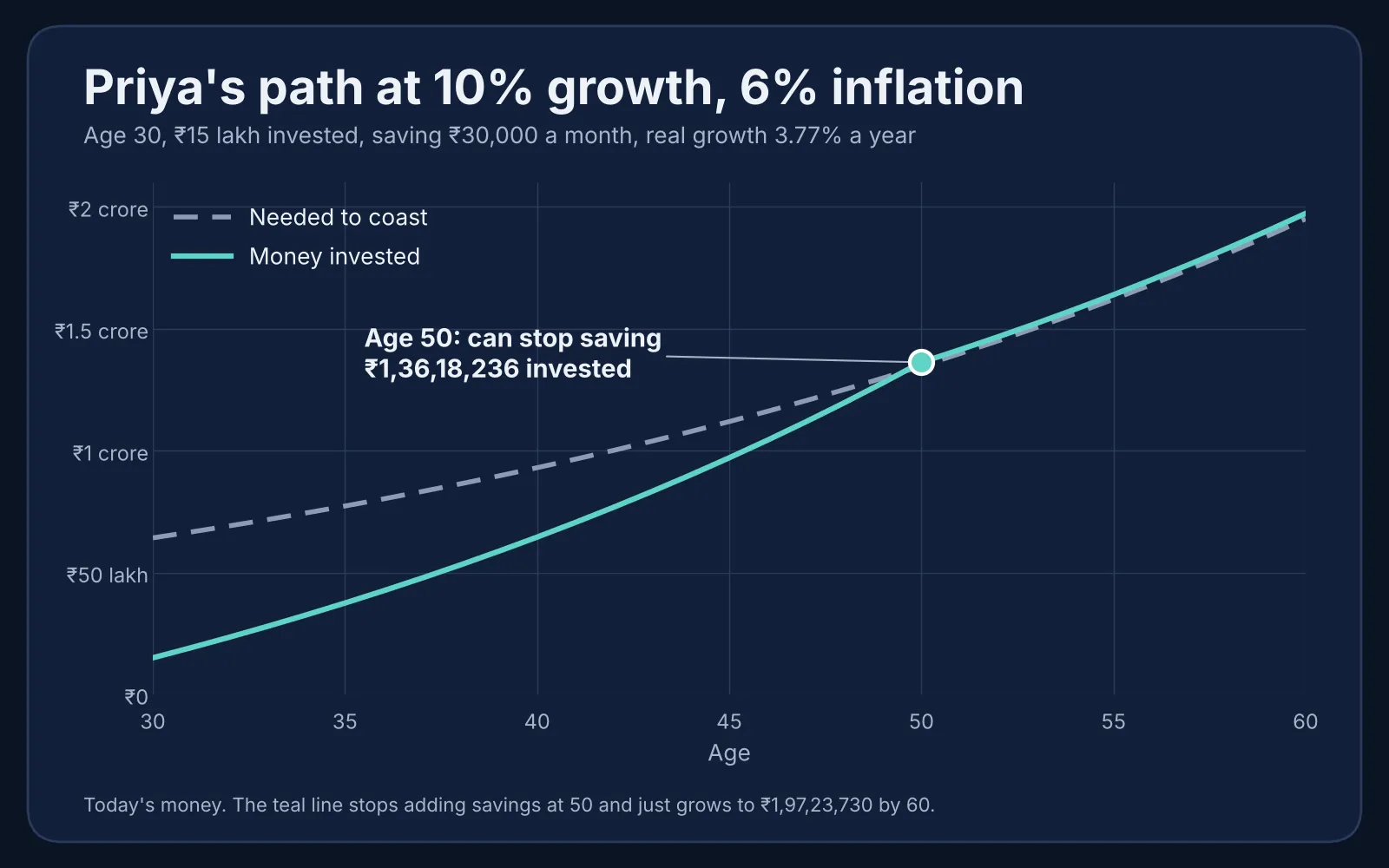
Their money invested (teal) meets the amount needed to coast (dashed) at 50. After that, they add nothing more for retirement.
Same couple, four sets of guesses
Here is the same plan with different growth and inflation figures. Everything else stays the same.
| Growth | Inflation | Real growth | Coast FIRE number today | They can stop saving at |
|---|---|---|---|---|
| 7% | 3% | 3.88% | ₹62,17,818 | 49 |
| 10% | 5% | 4.76% | ₹48,29,843 | 43 |
| 10% | 6% | 3.77% | ₹64,18,448 | 50 |
| 12% | 6% | 5.66% | ₹37,38,263 | 38 |
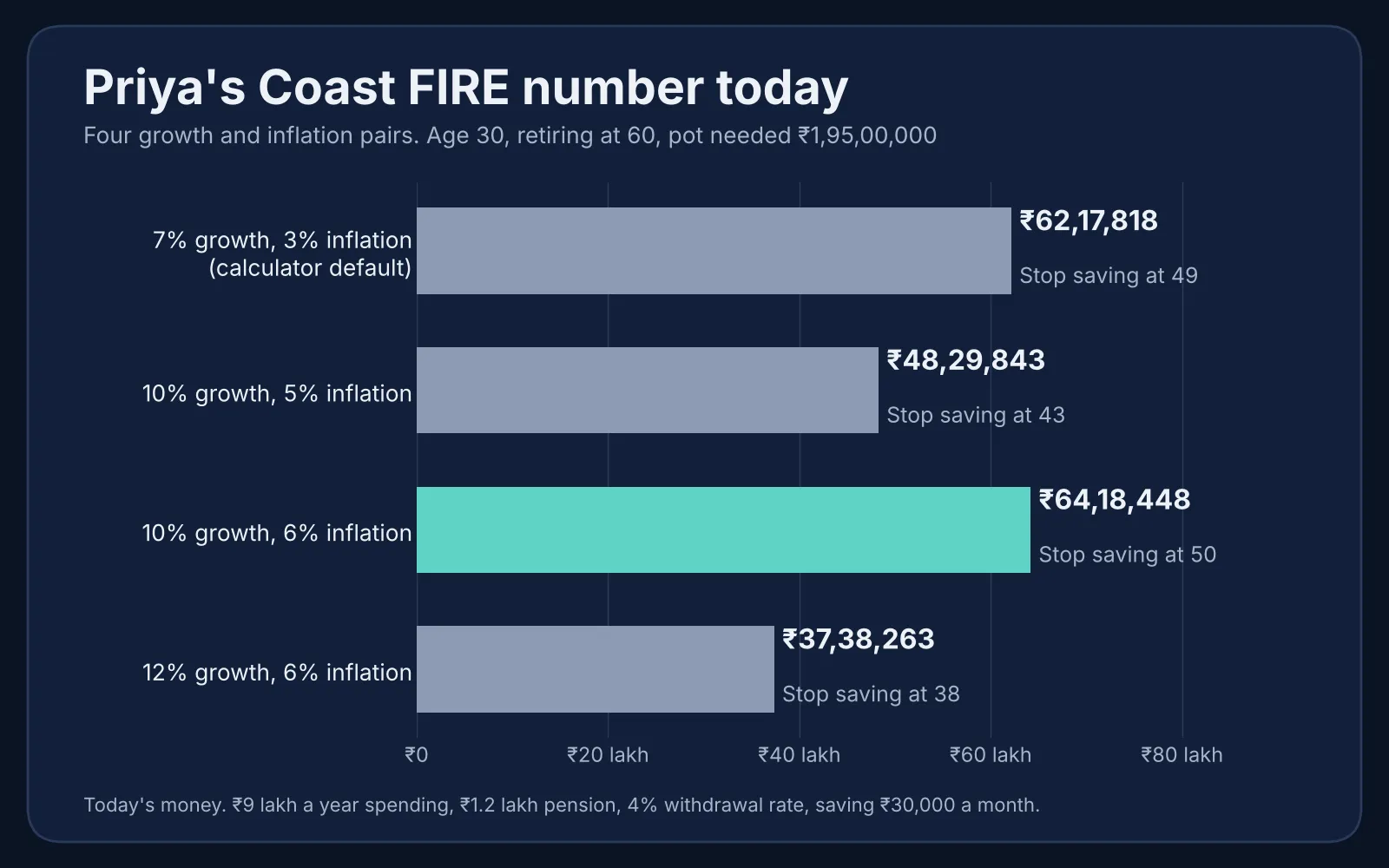
The calculator’s default and “10% growth, 6% inflation” give almost the same answer. About two points more real growth moves the stop-saving age by twelve years.
Two lessons stand out:
- The default is not far off for India, as long as you read it as “about 4% real growth”.
- Optimism is expensive. At 12% growth and 6% inflation, Priya and Arjun would think they could stop at 38. If the real gap turned out to be smaller, stopping that early could leave them well short. Plan with the careful figure and treat anything better as a bonus.
How saving more changes the date
At 10% growth and 6% inflation, a bigger monthly saving brings the stop-saving age forward:
| They save | Stop-saving age |
|---|---|
| ₹30,000 a month | 50 |
| ₹35,000 a month | 46 |
| ₹40,000 a month | 44 |
| ₹50,000 a month | 40 |
An extra ₹5,000 a month buys them four years. That is a trade they can weigh today.
What counts as “money invested” in India
The calculator has one box for money invested and one for monthly saving. Here is how common Indian accounts fit in.
- EPF (Employees’ Provident Fund). Count your EPF balance as invested, and count both your share and your employer’s share of contributions in your monthly saving. EPF pays a set interest rate each year. For 2025–26, the EPFO’s Central Board of Trustees recommended 8.25%, according to the government’s press release. The rate is reviewed every year, so it can change.
- PPF (Public Provident Fund). Count the balance as invested. The rate is set by the government every quarter. Your bank or post office can tell you the current one.
- Mutual funds and shares. Count what you hold for retirement. Leave out money set aside for nearer goals.
- NPS (National Pension System). Since the PFRDA’s December 2025 changes, most non-government subscribers can take up to 80% as a lump sum at normal exit and must buy an annuity with at least 20%. Count your NPS balance as invested. When you retire, the annuity part turns into a pension, so you can move that share into the pension box once you know roughly what it will pay. Government sector subscribers have different rules.
- Fixed deposits and gold. Count them only if you will really use them for retirement. A gold necklace you will pass on is not part of the pot.
One caution about blended growth. EPF and PPF pay fixed rates, while equity funds go up and down. If much of your money sits in fixed-rate accounts, your overall growth may be lower than an all-equity figure. Pick a growth figure that fits your whole mix.
Counting pensions in India
The pension box is for regular income you will get in retirement, in today’s money. In India that could be:
- An EPS pension from your EPF years. The amount depends on your service and the scheme rules, and in March 2026 the EPFO board approved a new scheme to replace the 1995 one. Check your own statement rather than guessing.
- An NPS annuity. Many annuities pay a fixed amount that does not rise with prices. If yours is fixed, its real value will shrink, so enter a lower figure to be safe.
- A government pension, if you have one from older service rules.
- Rent from a property you will keep, after costs.
Every rupee of yearly pension saves you 25 rupees in the pot, at a 4% withdrawal rate. Without their ₹1,20,000 pension, Priya and Arjun would need ₹2,25,00,000 instead of ₹1.95 crore, and at 10% growth and 6% inflation they would have to save until 57 instead of 50. Coast FIRE with a pension shows how to count pension income safely.

Questions people in India often ask
Should I retire at 60 or later? Many people in India plan around 60, so it is a natural starting point. Retiring later gives your money more years to grow, and fewer years to pay for.
What about my children’s education and weddings? Keep big family goals separate. Coast FIRE covers your retirement only. Save for school fees or a wedding as their own goals, on their own timeline.
Is the 4% rule safe in India? The 4% rule comes from US research. With higher inflation and a long retirement, many people prefer to plan with 3.5%. The 4% rule explained shows what that does to your number.
What about healthcare? Medical costs can rise faster than general prices. Include health insurance premiums in your yearly spending, and consider a slightly higher inflation figure if you expect large medical costs.
Five steps to work out yours today
- Add up your EPF, PPF, NPS and retirement mutual funds. That is your money invested.
- Add up what goes in each month, including your employer’s EPF share. That is your monthly saving.
- Write down your yearly spending in retirement, at today’s prices.
- Open the calculator, choose India, and run your plan at 10% growth and 6% inflation.
- Then try 10% and 5%, and the default 7% and 3%. If your stop-saving ages are close, you have a sturdy plan. If they are far apart, plan for the later one.
Every setting is explained on the methodology page.
Work out your own number
Your number depends on your spending, your pension and the gap between growth and inflation you choose. Seeing two or three versions side by side tells you more than any single answer.
Find your Coast FIRE number. It works for singles and couples, includes pensions, and shows every step of the maths with your own figures in rupees.
This article is for education, not financial advice. All figures are in today’s money and do not include taxes or fees.
What is your Coast FIRE number?
Find the age you can stop saving for retirement. Free, no sign-up, and your numbers stay on your device.
Find your own Coast FIRE numberPhotos: Ketut Subiyanto, Ketut Subiyanto on Unsplash.