Coast FIRE in Canada: CPP, OAS, RRSP and TFSA
By Gourav Boruah · October 22, 2026 · 10 min read

Coast FIRE in Canada works the same way as anywhere else: once your investments can grow into your full retirement pot on their own, you can stop saving for retirement. What makes Canada different is that most people get two public pensions, not one: the Canada Pension Plan (CPP) and Old Age Security (OAS). Counting them properly can cut your Coast FIRE number by more than two thirds.
Want your own number first? Use the Coast FIRE calculator. It takes a minute and nothing is sent anywhere.
If “Coast FIRE” is new to you, start with what Coast FIRE is. All amounts in this article are in Canadian dollars.
CPP and OAS: two pensions that work very differently
The Canada Pension Plan is earned by working. You and your employer pay into it from your pay, and what you get depends on how much and for how long you paid in. For 2026, the maximum at 65 is $1,507.65 a month, but very few people get that. The average for someone starting at 65 was $858.34 a month in July 2026, according to Canada.ca.
You can choose when CPP starts. Starting before 65 lowers it by 0.6% for each month, up to 36% less at 60. Waiting past 65 raises it by 0.7% for each month, up to 42% more at 70, as Canada.ca explains. If you live in Quebec, you pay into the Quebec Pension Plan instead, which works in a similar way. Check your own figures with Retraite Québec.
Old Age Security is not linked to work. It depends on how long you have lived in Canada. For October to December 2026, the maximum is $762.50 a month from 65 to 74 and $838.75 a month from 75, according to the government’s quarterly figures. A few things to know:
- Residence. You may not get the full amount if you have lived in Canada for fewer than 40 years after turning 18. If you live in Canada, you need at least 10 years to get a partial pension, as Canada.ca explains.
- Start age. OAS starts at 65 at the earliest. You can wait until 70, and it rises by 0.6% for each month you wait, up to 36% more.
- High incomes pay some back. In 2026, people aged 65 to 74 start repaying OAS when their net income is above $95,323, according to the same government figures. Most Coast FIRE plans spend well below that.
Why this matters so much: at a 4% withdrawal rate, every $1 of yearly pension saves you $25 in the pot. One average CPP plus a full OAS comes to $19,450.08 a year ($858.34 × 12 + $762.50 × 12). That does the work of about $486,252 of savings ($19,450.08 × 25). A couple with two of each has nearly a million dollars of “invisible” savings.

A worked example: Maya and Daniel at 33
Meet Maya and Daniel. They are both 33 and live in Ottawa. Between them they have $60,000 invested, counting their RRSPs, TFSAs and a group RRSP at Maya’s work. Each month $900 goes in, counting her employer’s matching payments.
They want to spend $55,000 a year in retirement, in today’s money. They plan to retire at 65, when both CPP and OAS can start. They do not count on the CPP maximum. Instead they each count the average CPP at 65 plus a full OAS, so together they will get $38,900.16 a year.
They use the calculator’s defaults: 7% growth, 3% inflation and a 4% withdrawal rate.
Step 1: The pot they need at 65. ($55,000 − $38,900.16) ÷ 0.04 = $402,496.
Step 2: Real growth. (1 + 0.07) ÷ (1 + 0.03) − 1 = 3.88% a year. That is how much faster their money grows than prices.
Step 3: How much $1 grows to in 32 years. 1.0388 to the power of 32 = about 3.38. Every dollar they have today becomes about $3.38 by 65, in today’s money.
Step 4: Their Coast FIRE number today. $402,496 ÷ 3.38 = about $118,920 (the calculator’s exact figure is $118,924.65).
With $60,000 invested, they are already 50% of the way there. If they keep saving $900 a month, they catch up at 40, with $163,339.35 invested. After that they can stop saving for retirement, and growth alone takes their money to about $423,403.69 by 65.
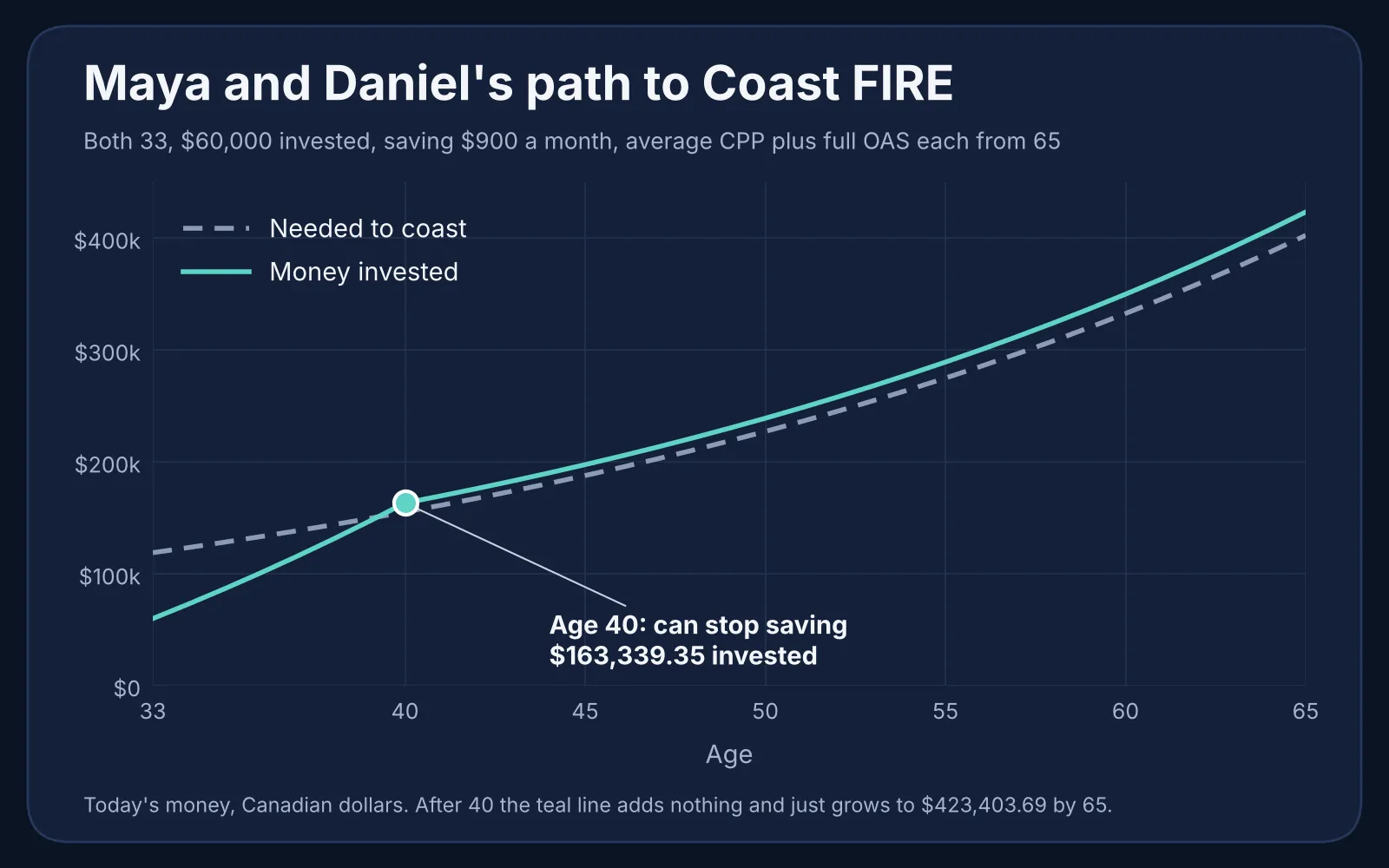
Their money invested (teal) meets the amount needed to coast (dashed) at 40. From then on, they add nothing more for retirement.
What if they count CPP and OAS differently?
Now the same couple, with everything else unchanged, but different pensions counted.
| Pensions counted (for both of them) | Pot needed at 65 | Coast FIRE number today | They can stop saving at |
|---|---|---|---|
| Average CPP + full OAS ($38,900.16 a year) | $402,496 | $118,924.65 | 40 |
| Full OAS only ($18,300 a year) | $917,500 | $271,091.80 | Not by 65 |
| No CPP or OAS | $1,375,000 | $406,268.36 | Not by 65 |
| Maximum CPP + full OAS ($54,483.60 a year) | $12,910 | $3,814.49 | Already there |
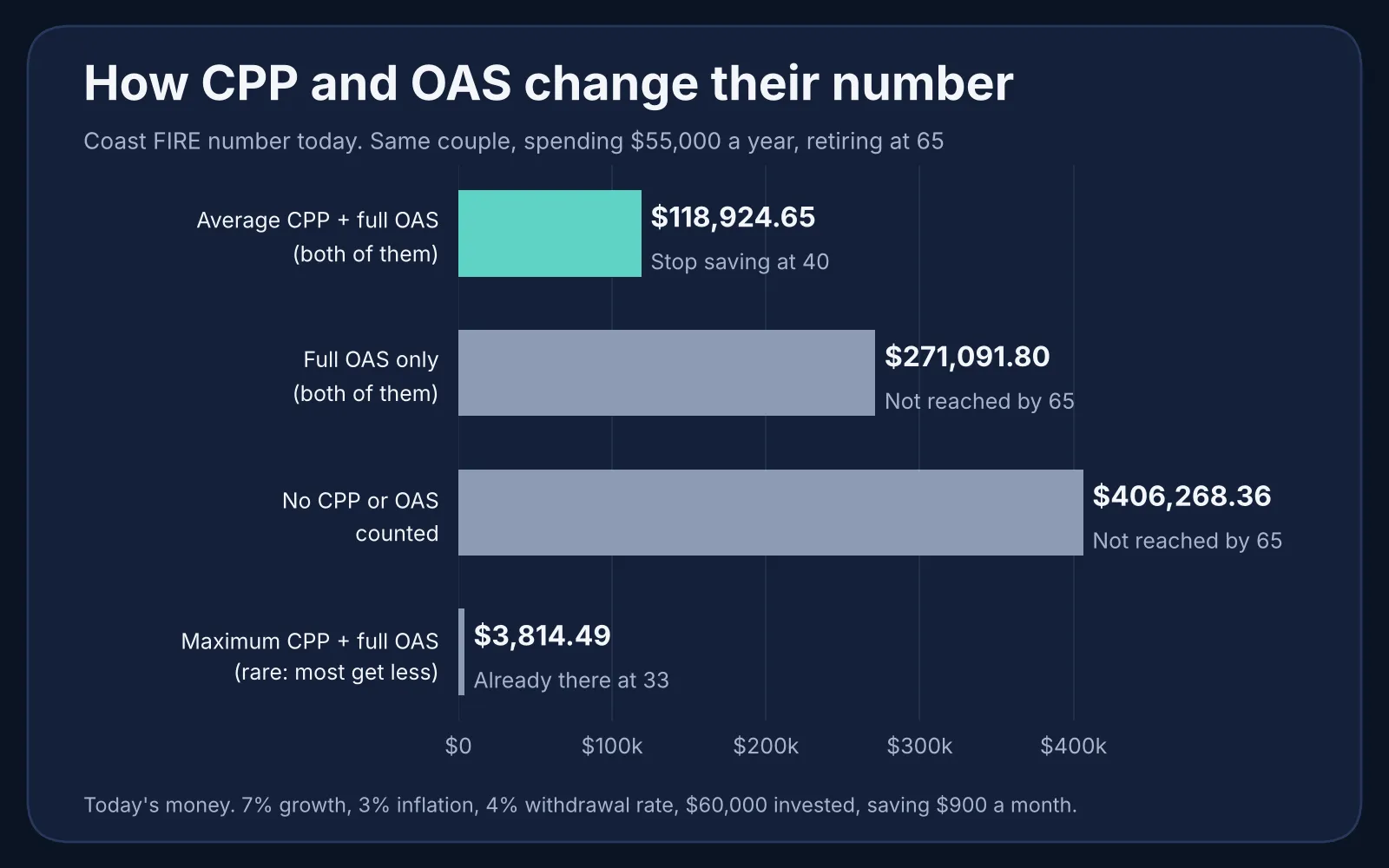
The pension figure you type in changes everything. Use your own estimate, not the maximum.
Two things stand out:
- Counting the maximum CPP is a trap. It would tell Maya and Daniel they are already done at 33. Most people never reach the maximum, so their plan would come up short.
- Leaving CPP out is too harsh. With OAS only, even saving $900 a month all the way to 65 would give them about $866,186.74, against the $917,500 they would need.
The honest middle is your own estimate. You can see your CPP contributions and an estimate of your pension in your My Service Canada Account. If you plan to work less after you coast, your CPP may end up a little lower, because you pay in less. Coast FIRE with a pension shows how to count a pension safely.
Two more checks they can run:
- A careful withdrawal rate. At 3.5% instead of 4%, they would need $459,995.43 at 65, their Coast FIRE number would be $135,913.88, and they could stop saving at 42 instead of 40. The 4% rule explained shows why some people prefer 3.5%.
- A different monthly saving. At $600 a month they would stop at 44. At $1,200 a month, 38.
RRSP, TFSA and workplace plans: what counts as “money invested”
The calculator has one box for money invested and one for monthly saving. Here is how the common Canadian accounts fit in.
- RRSP. Count what you hold for retirement. You can usually put in 18% of last year’s earned income, up to a limit of $33,810 for 2026, minus any pension adjustment from a work plan. Room you do not use carries forward, as the Canada Revenue Agency explains. Money you put in lowers your tax now, and money you take out is taxed later.
- TFSA. Count what is meant for retirement. The yearly limit for 2026 is $7,000, according to the CRA’s limits table. You get no tax break when you put money in, but what it earns is generally tax-free, even when you take it out, as the CRA explains.
- Group RRSP or defined contribution pension at work. Count the whole balance. In your monthly saving, include your payments and your employer’s.
- Defined benefit pension. This pays a set income, so it goes in the pension box, not in money invested. Use the yearly figure from your latest statement.
- Cash savings. Count only money meant for retirement, not your emergency fund.

When can you reach the money?
For Coast FIRE the question is not just how much, but when you can use it.
- TFSA money can be taken out at any time, with no tax. What you take out is added back to your room on 1 January the next year.
- RRSP money can be taken out at any time too, but tax is held back and it counts as income. In the year you turn 71, you must turn your RRSP into a RRIF, buy an annuity or take the money out, as the CRA explains.
- CPP can start from 60, at a lower amount. OAS cannot start before 65.
If you want to stop work before 65, you need money to cover those “bridge” years, and a TFSA is often how people do it. The calculator assumes your pensions start the day you retire. So if you plan to retire before 65, lower the pension figure to stay safe, or set your retirement age to 65, as Maya and Daniel did.
Tax and inflation: two notes for Canada
Tax. CPP, OAS and money from an RRSP or RRIF are all taxable income. TFSA withdrawals are not. The calculator works before tax, so if most of your pot will be in RRSPs, add a little to your yearly spending to cover tax. A mix of RRSP and TFSA money gives you more choice later.
Inflation. The Bank of Canada aims to keep inflation at 2%, the middle of a 1% to 3% range. The current agreement runs to the end of 2026, as the Bank of Canada explains, so it is due to be renewed. The calculator’s 3% default is a little more careful. What really matters is the gap between growth and inflation, not either figure alone. Why 7% growth is not really 7% explains this.
Questions people in Canada often ask
Should I count CPP and OAS at all? Most people do, because leaving them out makes the plan far harder than it needs to be. Use your own CPP estimate, not the maximum. If you worry about future changes, count a little less than your estimate.
I moved to Canada as an adult. Do I still get OAS? You may get a partial OAS, based on how many years you have lived in Canada after 18. Count only what you expect to get, and check the rules on Canada.ca.
We are a couple. Does each of us get CPP and OAS? Yes. Each person has their own CPP record and their own OAS. Coast FIRE for couples shows how to plan together, including different ages.
Should I take CPP at 60 or 70? It is a personal choice that depends on your health, your other money and when you stop work. For a simple plan, use your estimate at 65 and retire at 65. You can test other ages in the calculator.
Does my house count? Most people leave their home out of money invested, because they still need somewhere to live. Rent from a property you will keep can go in the pension box, after costs.
Five steps to work out yours today
- Log in to your My Service Canada Account and note your CPP estimate at 65. Work out how many years you will have lived in Canada after 18 for OAS.
- Add up your RRSPs, retirement TFSAs and workplace plans. That is your money invested.
- Add up what goes in each month, including your employer’s payments.
- Open the calculator, choose Canada, and enter your figures with your CPP and OAS in the pension box.
- Run it again with OAS only, and again at a 3.5% withdrawal rate. If the stop-saving ages are close, your plan is sturdy.
Every setting is explained on the methodology page.
Work out your own number
Your number depends on your spending, your CPP and OAS and any work pension, and the gap between growth and inflation you choose. Seeing two or three versions side by side tells you more than any single answer.
Find your Coast FIRE number. It works for singles and couples, includes pensions, and shows every step of the maths with your own figures in dollars.
This article is for education, not financial advice. All figures are in today’s money and do not include taxes or fees.
What is your Coast FIRE number?
Find the age you can stop saving for retirement. Free, no sign-up, and your numbers stay on your device.
Find your own Coast FIRE numberPhotos: Leah Newhouse, Priscilla Du Preez, Land O'Lakes, Inc. on Unsplash.